Showing posts with label MusicalFilm. Show all posts

18 April 2015

#WTW: Phantom of the Paradise

(#WhatThomWatched spooky-scary #23)

#WTW: Phantom of the Paradise

Phantom of the Paradise

(1974, Brian De Palma; Shout! Factory disk)


By rights, Brian De Palma’s horror/comedy/musical should be at least as famous as The Rocky Horror Picture Show, which was gestating at the same time, but Phantom of the Paradise was plagued by horrible luck when it opened in 1974. As detailed in the 2006 French documentary Paradise Regained (included on the recent Scream Factory release), the film was hit with no fewer than four lawsuits in the days just after post-production wrapped, seriously hampering its release: Universal called the film an infringement on the Lon Chaney Phantom of the Opera from 1925; King Features sued as the owners of the comic book character “The Phantom”; the manager of a rock frontman who had been tragically electrocuted onstage in a manner uncomfortably close to a comic death in the film sued for defamation (not named in the docu, but most likely Peter Grant, manager of Stone the Crows guitarist Les Harvey, killed in 1972); and, most damaging to to De Palma’s intricately crafted production design, Led Zeppelin. Their record label had just been registered as “Swan Song Records,” and their manager (Peter Grant again) didn’t like the use of “Swan Song Enterprises” as the name of the fictional company in the movie, run by the evil impresario played by Paul Williams. The filmmakers were forced to use very obvious optical mattes to cover up names and logos throughout the movie, ruining many scenes; other shots had to be cut entirely. The title had to be changed (from the original’s simple Phantom) and all the artwork and promotional materials redesigned. And then the premiere was an unexpected disaster — the audience just didn’t get it. (Except, oddly, in Winnipeg, which is still the center for Phantom phandom worldwide.)*
#WTW: Phantom of the Paradise

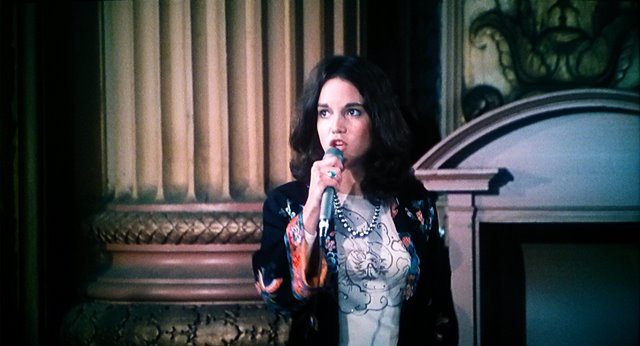
Phantom’s ambitious story combines several classic psychological horror plots: in addition to the Gaston Leroux serial from 1909-1910 in which a deformed and frustrated artist haunts the venue where he was ruined, lusting after the pure woman who is his last connection to humanity, the movie also loops in the Faust story and Oscar Wilde’s “The Picture of Dorian Gray.” Williams makes for a singularly seductive Mephistopheles, from his purring voice to his affected dress; he’s smartly cast to set his diminutive size and seeming harmlessness against his all-powerful, all-seeing evil; his henchman played by George Memmoli is huge in contrast to Williams. William Finley as (first) the hapless and goofy songwriter taken advantage of by Williams, and (later) as the mangled and tortured monster again bested by Williams, is beautiful to watch, with so much of his performance in his carriage and the one visible eye through his mask; in one nicely underplayed gag, all of the door frames in both Williams’s mansion and studio are 5” 6’ to accommodate him, forcing Finley to grotesquely contort his body to get through them. The ingenue and Finley’s obsession is played by Jessica Harper, who projects wholesomeness and likability even as she proves to be just as ambitious as both Finley and Williams. Finally, four key musical frontmen play the contract employees of Williams’s conglomerate who are tasked with delivering his music to the masses, packaged and repackaged to fit the latest trend: Archie Hahn, Jeffery Comanor, and Peter Elbling front doo-wop band The Juicy Fruits, surfer band The Beach Bums, and shock-rockers The Undeads in turn, with Gerrit Graham added to the final band as the lead singer intended to carry the Faust role written by Finley (and which he’d intended for Harper). The changing bands, cynically sold as the next hot thing, are a powerful conceit, explicitly accusing mass media and mass entertainment in the grinding down of art and artists, while implicitly criticizing the (teenage?) audience that drives the evil empire with their undiscerning consumption. (There’s some suspicion in the documentary material on this disk that this theme wasn’t understood by the distribution people at Fox, who tried to sell the movie to the same teens that were being satirized, with mixed results.)


#WTW: Phantom of the Paradise

#WTW: Phantom of the Paradise

#WTW: Phantom of the Paradise


The De Palma hallmarks are all there — fully developed, in a surprisingly early entry in his oeuvre. It has his Hitchcock homage, an attack in a shower a la Psycho. It has his split-screen, here serving a truly tense scene: two angles on the same band rehearsal allow unsuspecting dancers and musicians to run into a time bomb that’s been planted in a rolling prop car, with the cameras following each as the car comes closer and closer together and eventually (after several minutes, during which the bomb’s ticking is heard throughout) reaches them just at the moment of mayhem. Another De Palma specialty is shown off in the long final scene, the Williams-Harper wedding sequence. Using the experience he’d gained with documentary-style continuous shooting for Dionysus in 69, De Palma put all of the cameramen in costume as members of William’s ubiquitous press photographers. De Palma’s choreographers-cum-crowd-wranglers were tasked with organizing the scene’s overall action: the primary actors had lines, blocking, and marks to hit; other actors had specific bits of business they had to fit in; the remaining extras mostly had to stay out of the way. Then the entire sequence was filmed in one go, with everything taking place in real time pretty much as it does in the final film. De Palma had to trust that he would have enough varied footage to cut together to tell his story; the end result (reportedly from only two takes) feels “real” in a sort of hyped-up, media-exaggerated way — furthering the overall theme of corporations manufacturing and selling packaged, inartistic experiences.

#WTW: Phantom of the Paradise

#WTW: Phantom of the Paradise

#WTW: Phantom of the Paradise

Reminds me of:

Rocky Horror, obviously . . . . I love The Rocky Horror Picture Show as much as the next seventies kids, but Phantom has far more going on than Richard O’Brien’s goof on RKO B-pictures ever did. Rocky gets its shocks (and, frankly, most of its value) from transgression and its twisted one-to-one cooption of each beat from square, classic horror movies; that’s made clear from its first scene (listing the science fiction and horror films it will cite) to last (where the RKO logo is literally the portal back to the alien world). There’s no real social satire in Rocky beyond its minimal critique of the “straight world” suburbia of Denton contrasted with the freaks and the freak nature that apparently exists in everyone. The joys of Rocky really surface when the movie is beside-the-point, just a canvas for a communal experience where theatergoers yell and dance and throw things at the screen. Phantom, in contrast, actually rewards close watching; like all De Palma films, it’s a beautiful object which opens up to reveal hidden themes and ideas.
#WTW: Phantom of the Paradise


Of course both Rocky and Phantom have great music. Williams’s songs and score are just perfect; it’s a bonus that several of the numbers are intended to mimic and poke fun at certain popular rock styles to be sung by the three iterations of Swan Enterprises' house musicians reconstituted as 1950’s greasers, 1960’s surf dudes, and 1970’s shock rockers (like Alice Cooper). Every time Williams composed for the the screen, he turned out exceptional work: The Muppet Movie, the “intentionally bad” songs for the songwriters in Ishtar, Bugsy Malone (which has subsequently been turned into a stage musical), A Star is Born. I wish he’d been given as many chances over the years to score films as the (admittedly also awesome) Randy Newman. (Interestingly, given this movie’s plot point of a composer creating “the first rock version of 
Faust,” Newman wrote his own (not very successful) Faust in the mid-1990’s; I have the concept album.)

#WTW: Phantom of the Paradise


The sequence of the bomb being placed in a prop car trunk is a clear echo of Welles’s famous opening shot for Touch of Evil, where the camera follows a bomb-laden car through a border crossing in continuous real-time; the double-framing is almost a one-upmanship in terms of technical prowess. It’s not as beautiful as some of his other split-screen work (I’m very partial to images in Blow Out) but it is chillingly functional. I’m sure De Palma put in a zillion more directorial homages beyond Hitchcock and Welles; I’m too dense to find them, but I’ll say (betraying my personal obsessions again) that the ever-present cameras and Williams’s console of spying video screens reminds me of Dr. Mabuse in general and specifically of my favorite, Lang’s The 1,000 Eyes of Dr. Mabuse.
#WTW: Phantom of the Paradise

#WTW: Phantom of the Paradise

#WTW: Phantom of the Paradise

But then — the guilt!

This movie has plenty of recognizable character actors and repeat De Palma performers, but I was particularly bothered by Archie Hahn, one of the three contract musicians and the lead singer of the first number, the Juicy Fruits’ “Goodbye, Eddie, Goodbye” — he felt so familiar to me, like an old friend you recognize at a party and just can’t place. I looked at his long credits list in IMDb for a while before it came to me: He has that literally-five-seconds-long role in This is Spinal Tap as the hotel employee delivering room service to the band, with the absolutely perfect line delivery: “Thank God! Civilization!!”
#WTW: Phantom of the Paradise

Watching Paul Williams’s performance and listening to his songs, and then seeing him on this disk’s extras (in particular a long interview conducted by his friend, director Guillermo Del Toro) reminded me yet again of the apparently superlative 2011 documentary about Williams’s career and fight with drug addiction, Paul Williams Still Alive. It’s on my neverending list of films to see, and now it bumps up a notch or two.
#WTW: Phantom of the Paradise

Actor William Finley thinks that the Phantom costume he helped design — full-head mask, black leather body, cape — was ripped off for Darth Vader in Star Wars VI: A New Hope, specifically the blue-and-red light-up pushbuttons on the chest. This is in the BTTG section and not the RMO section because, full admission: I would never have noticed this.
#WTW: Phantom of the Paradise

Pitch:

I think that you are either grabbed by the very first moments — the Juicy Fruits singing their 1950’s pastiche — or you aren’t. All of the show’s humor and appeal is right there. Or if you’re more of an old-school horror aficionado, the sequence where Finley is transformed into the monster is perfect — genuinely disturbing yet still funny and a clear connection to the horror films of the past.


#WTW: Phantom of the Paradise


* Pencils down for me: Now that I’m done writing this #WTW (and you, theoretically, are done reading it), it’s time to really dig deep into Phantom of the Paradise by exploring every corner of The Swan Archives. This tribute site is one of the best I’ve ever seen on the web — beautifully written and designed — and while it helped me avoid some obvious mistakes here, I promised myself that I wouldn’t indulge in their scene-by-scene visual analysis, their extensive production and release history, or their long list of artifacts and collectibles until after I’d posted my own hastily considered points, lest I outright steal their work. They carried the torch for Phantom for such a long time — becoming the official owners of the film’s outtakes and other cut scenes — that when it came time for Arrow Films and Shout! Factory to create these definitive editions in 2014, it was this site (the “Principal Archivist”) who provided all these extras to the two companies. It’s a master class in how fandom should work. Please go there now!


10 January 2015

#WTW Glance: Into the Woods

#WhatThomWatched Glance*: 

Into the Woods

(Rob Marshall, 2014; In theaters/Disc release announced for 24 March 2015, Disney Studios)


Recommended for: Those enamored (or potentially enamored) of Sondheim (but not so enamored that a neutered version of one of his greatest works will bother them) . . . .


Fairy tale deconstruction has probably been around as long as the fairy tales themselves. The Washington Post just reviewed new fairy tale books which include the first two entries in a Princeton reprint series called “Oddly Modern Fairy Tales” originally published in the 1920’s and 30’s; these are two of many examples of post-modern takes on the Mother Goose versions from the 1700’s, and they’re coming on a hundred years old themselves. After Disney did The Three Little Pigs mostly straight in 1933 (winning the animated short Oscar and adding “Who’s Afraid of the Big Bad Wolf?” to the lexicon), Warners responded with parody versions: 1943’s Pigs in a Polka, 1953’s The Three Little Pups, 1957’s The Three Little Bops and so on; the trend continued through Jay Ward and Bill Scott (television’s Fractured Fairy Tales), writers like William Steig (Shrek) or Jon Scieszka (The Stinky Cheese Man), and even Disney parodying themselves (in 2007’s Enchanted). These examples are all more or less satirical of the form.


When Sondheim and his collaborator James Levine created Into the Woods in 1986, they were going for something more than parody or pastiche. When they weave the storylines and material from several fairy tales together, they are honoring the form. They take domestic and childhood themes — family, both finding and losing it; children obeying or disobeying or breaking away; what “happy ever after” would actually imply — and express them for adults, in a sophisticated way. There’s certainly ironic humor — for example, as the narrator matter-of-factly describes the birds which peck Cinderella’s mean stepsisters’ eyes out — but the events are as serious and consequential as anything in Andrew Lang's Fairy Book versions. The result was a celebrated musical which has won awards in several productions.


As a movie translation, Marshall's Into the Woods is solid (but: see below). The cast is uniformly excellent; the sets (with exteriors filmed in England, naturally) are tactile and gorgeous; and as pointed out elsewhere (I noticed it first in Jesse Hassenger’s A.V. Club review) Sondheim's fluid lines force the takes to flow in-camera for long strokes, with none of the staccato cutting that plagues other recent movie musicals (most relevantly, Marshall’s own Nine and Chicago).


Reminds me of:

I’m a Sondheim fan and I have been fortunate enough to see some of his masterworks in excellent productions — I caught Assassins in Indianapolis in 1993 which (if my memory serves me) was one of the early regional productions in which Sondheim introduced “Something Just Broke”; and Sunday in the Park with George at the Goodman Theater in 1987, where we were proud to consider that we were watching the show mere yards from the actual Seurat "Sunday Afternoon on the Island of La Grande Jatte" hanging at the Art Institute of Chicago — but I’ve never seen Woods performed. Compromised or not (whoops; spoilers; again, see below), the music is wonderful and the old “You leave the theater with no tunes you can hum” complaint about modern composition is belied by the fact that I caught myself belting out “Into the woods!”, compulsively, days later. (Uh, not that I had much follow-up.)


But then, the guilt!

So, finally, here’s the rub — and the issue which has had Woods fans up a tree about this screen adaptation: A thespian friend of mine, one who was in a production of Into the Woods, has clued me into the differences between the original musical and the movie, starting with the fact that the character he played on stage was cut completely. I had already told him that I loved the music and was generally impressed with the book — but that a few second-act unresolved storylines had bothered me; without any hints from him, I had zeroed in on some of the missing dark bits (live characters that should have been dead, dead ones that should have been . . . . less pleasantly dead). The original show’s parts all lock together as a Sondheim show’s parts will do — meaning that sunny, whimsical themes from a first act are repeated as tragedy in the second; here, we have most of the setup and not quite all of the punchline. The stage version also benefits from a Narrator character who engages the audience more directly (as an actor on stage tends to do), and who transitions into an important figure in the stories proper; this entire interplay vanishes from the film. And while a large-screen, literal image can be gorgeous, there are many ways in which a live staging, dependent on innuendo and unseen things, is more visceral: paradoxically, the Disney version suffers where it shows (even a hint) of, say, a giantess (which could only be imagined on stage), and suffers again when it whitewashes the second-act fates of some characters by failing to show their true ends on screen.


On top of that, the most cursory investigation into the original creation and production of the show makes it clear that it was very much a reaction to its time — specifically, to the AIDS crisis which was at its peak in 1986 when the show opened. Actors in early productions were doubled between the first and second act in roles that connected and commented on each other; for example, the Wolf (whose part is over early in the show) comes back as Cinderella’s Prince, drawing a comparison between the beast's and the man’s treatment of women. Child characters (Little Red Riding Hood, Jack) who are played by age-appropriate child actors in the movie were played by adults in most productions, freeing the show to explore much more explicit themes of carnality and sexual threat. This doesn’t mean that a whole-family Disneyfied version of the same material is worthless, but it’s certainly constrained.


And while I’m piling on . . . . Yes, I loved every line of (retained) music and thought the actors did an honorable job — and yet by the end I had to admit to myself that the overall two hours were . . . not particularly exciting. It’s partially my temperament: I’m not terribly interested in seeing “movie stars” take on Broadway roles. Bob Fosse’s Cabaret is still my gold standard for a modern (i.e. post Rodgers-and-Hammerstein) movie adaptation of a stage musical — which largely works, of course, because the songs are naturalistically placed within the context of the stage-within-the-movie, just as songs are placed within performance contexts in his later All That Jazz.


Pitch:

Maybe I'm just still attuned to bratty little girls after #WTW 8's Alice, but I was particularly taken by Lilla Crawford's Little Red Riding Hood and her song I Know Things Now. (Viewing this with the AIDS crisis context in mind renders it that much more effective.)


*For movies and shows which are current — in theaters or streaming — I'm posting a short, less-spoilery take on #WhatThomWatched (and generally only when something really strikes me as worth passing on). These shorter essays are labeled Glance.

03 December 2014

#WTW: All That Jazz

(#WhatThomWatched the third)


#WTW All That Jazz: Hands


All That Jazz 
(Bob Fosse, 1979; Criterion spine 724)

Roy Scheider is indelible in his high-profile 1970’s roles: as Gene Hackman’s turtlenecked, slicked-down partner in The French Connection, or behind those large wire-frames and that drooping cigarette in Jaws, muttering about a bigger boat. He’s a great actor in much lesser movies too, and even in his three seasons on television’s seaQuest DSV. But his Joe Gideon in All That Jazz is transformational — his greatest creation. A thinly-disguised double for choreographer and film director Bob Fosse, Scheider is completely convincing as a sardonic, driven genius with many weaknesses — not least an unending internal flow of self-doubt which belies his massive talent, accomplishments in multiple spheres, and huge circle of family and collaborators who love and accept him (ex-lovers just as strongly as anyone). In All That Jazz’s brave construction, naturalistic scenes of casting a Broadway show, rehearsals, choreography sessions, and film editing are interwoven with a fantastical visualization of that stream-of-consciousness in the form of a conversation with a beautiful angel of death, expanding in the film’s final thirty minutes to an extended dream sequence as Gideon, hospitalized for heart surgery, drifts toward and away from life's end. Musical numbers thus fit seamlessly into either narrative strand: as real-life scenes based on Gideon’s choreography job, or as internal fantasy. The editing (by longtime Fosse collaborator Alan Heim) between and among these points of view is mind-blowing.


#WTW All That Jazz: Mirrors...

#WTW All That Jazz: ...and mirrors...


#WTW All That Jazz: ...and more mirrors.


Reminds me of


From our perspective now, so much of what Fosse did has been imitated, badly, and the endless bad imitations have been endlessly mocked; consider Exhibit A: "Jazz hands!!” And yet none of this takes away from the real thing in the least. Viewing other musicals from the same late-seventies-early-eighties time frame, we see a few “big numbers” that have some superficial resemblance to Fosse — that endless roller disco in Xanadu, or the ridiculous “Satan’s Alley” production in Staying Alive — but they don’t compare; in fact, the final dying hallucinations in Jazz are so unique and so bold that I’m hard-pressed to come up with anything similar. I do like to imagine that Forbidden Zone, the no-budget cult film directed by Richard Elfman and featuring the first score by his brother Danny Elfman, took some inspiration from the Fosse visions in Jazz which had been released just the previous year; extended sequences in Zone are set in Hell and have avant-garde images which resemble the do-it-yourself version of a full-Technicolor musical, and indeed the two movies both use the Shelton Brooks standard “Some of These Days” (sung by Gideon’s daughter in the surgery hallucination, while characters in Zone lip-sync to Cab Calloway’s version). For that matter, the use of repurposed standards — both early stage songs and newer pop like “Bye Bye Love” — with altered or recontextualized lyrics to further the story is a trick used in movies like Moulin Rouge, and, I suppose (to lesser effect) in the current rash of “jukebox musicals.”

I'm also a complete sucker for the metaphysical games which occur when a helpless, muzzled version of Scheider's character is confronted by his mocking doppelganger:


#WTW All That Jazz: "You don't have any lines here."


But also — the guilt! 

I need to re-watch Fosse’s Lenny, the Lenny Bruce biopic which shows up as a work in progress in Jazz under the name Standupand I need to watch or re-watch all of his other films, even the failures, just to see more of his work! (that includes his early choreography jobs like Damn Yankees and his underperforming Sweet Charity, and of course the flawless Cabaret). Just generally, there are a slew of hard-edged musicals which I’ve never seen. (I just got Criterion’s Jacques Demy collection on Blu-ray, six weepers, of which I’ve only seen Umbrellas of Cherbourg in the past -- so that’ll help even the score. No pun intended.)


#WTW All That Jazz: Dying


#WTW All That Jazz: Dying with style


Pitch:

Every musical number, dream or real, is a keeper, but if I had to pick one . . . . I have a friend, a singer and pianist who has recorded several albums, one of which contains (and is named after) the Peter Allen standard “Everything Old is New Again,” which has become part of my own endless internal monologue*; that number, danced in Jazz as a surprise gift for Scheider’s character by his daughter and his lover (Erzsébet Földi and Ann Reinking), is perfect — a perfect performance of a perfect song. It’s not representative of the movie’s tone — it is the peak from which the characters must fall — but it’s still a pretty good reason to watch the whole. “Let’s go backwards when forward fails . . . .”


*If you’re interested, search for “Daryl Ott, Everything Old is New Again” in iTunes, Amazon, or your favorite source for digital music.


#WTW All That Jazz: Joe contemplates