
The Trial
(1962, Orson Welles; Streaming via Netflix)

Anthony Perkins plays Josef K., a successful mid-level bank manager who is interrogated in his apartment by two government goons in the first scene, told only that he will be facing charges in an upcoming court trial — but that he cannot know the charges against him, when he will be tried, or even who will act as his advocate. Perkins is not without resolve and courage, and so he attempts to meet the situation head on — demanding answers, trying to work his way through the bureaucracy, and so forth (in this way Welles has somewhat altered the K. of the novel, who is more passive; here some elements which were merely internal thoughts of the novel’s milquetoast K. are brought out and shown to us as (futile) actions) — but instead he’s dragged deeper and faster into a maddening series of increasingly confusing scenarios. As he seems to get a handle on one challenge, the rules shift beneath him and he winds up in a worse situation. Along the way he meets several absurd characters, some diabolical but many ostensibly helpful, and has a series of conversations and encounters. It ends as badly as anyone would expect, inevitable from the first frame.

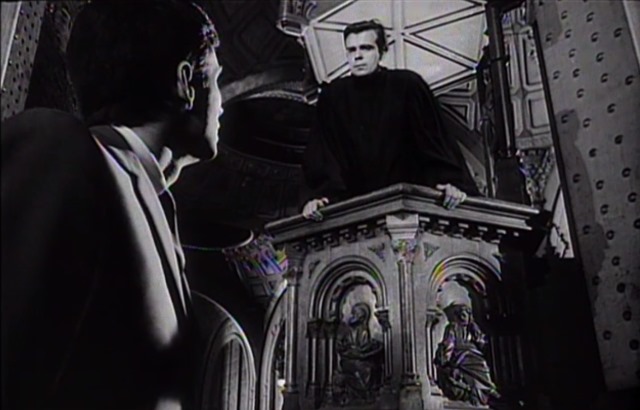
Near the end of the novel, K. meets a priest who tells him a fable called “Before the Law” (which Kafka had previously published as a stand-alone short story). In the film, Welles asked the art animators Alexander Alexeïeff and Claire Parker to create a series of stills illustrating the fable, using their laborious “pinboard” technique (in which images are created by pushing tiny pins set in a grid pattern some distance through a board — like the toys which allow an impression to be made of an object with sliding pins — and photographed by a light source shining from the side, so that a picture is formed by the oblique shadows of the pins). Welles narrates the stills to create a short film of the fable, and this opens the movie; later, at the point in the story where the fable is told to K., the images are shown as projected slides on a screen. Welles in his character as K.’s antagonistic Advocate controls the projector; Perkins as K. is trapped in the beam, arguing for his life as the images bathe his body in light and darkness; this replaces the book’s exegesis of the fable between the Priest and K. Every element of Kafka’s text, every effect he creates through K.’s internal narrative and confusion, has to be transformed by Welles into a cinematic experience of image and sound; he is a translator, just as Willa and Edwin Muir had to render Kafka’s words in English from the original German in 1937, except that Welles knew that he had to escape words themselves, using pure cinema to create an analogue emotional experience for the viewer. Every scene of The Trial is like this; every choice Welles made (some completely successful, others not) is in service of this mission. And in making these choices, Welles left a staggering amount of material to inspire future artists dealing with similarly-minded projects. The possible connections between The Trial and other films seen and as-yet unseen are myriad.

Reminds me of:
So with that in mind: As I was clipping stills for this #WTW, I found myself arrested by composition after composition. I finally made myself stop — arbitrarily — once I’d grabbed a hundred “too good to pass up” frames. After a couple general Reminds me of paragraphs, I’m going to switch into a mode that I haven’t used in past pieces; I’m just going to share a few of these shots and talk about what they evoke for me. But first, here are just a couple of the most obvious connections my mind leapt to during Welles’s film:If you’ve read #WTW 8 (Svankmajer’s Alice), you know that I’m an Alice in Wonderland freak. I’m not claiming any academic literary connection between Carroll and Kafka, but of course The Trial shares a structural conceit in common with the Alice books and with plenty of other satirical works: It’s episodic, with our identification-figure hero(ine) meeting a series of mad (British-sense-crazy-mad and plain old American-sense-angry-mad) characters, some helping, some hindering, but all frustratingly enigmatic. My limited research would seem to indicate that despite his rehabilitation in 1963 by some Czech scholars, Kafka is not generally recognized in his native Czech Republic* as a major intellectual force; as he wrote exclusively in German and his books were banned for the better part of half a century, he’s better known in Europe and in America via the English translations of the Muirs. But subversives like Svankmajer couldn’t have missed him — he along with all of the Czech New Wave filmmakers came roaring out of the gate in the mid-1960’s just as Kafka gained some regard among the Czech intelligentsia. I have no idea if Svankmajer studied Welles’s film, but in the specific case of Něco z Alenky there are several strong visual connections: repeated doors and passageways, sometimes leading to remote and unexpected spaces (often literally via a cut in Welles’s case); outrageous differences in scale, specifically between a person and a door in the Alice story and in one Trial shot; objects piling up and becoming obstacles (mountains of paper in The Trial; socks and other items in Alice), and many more — just the decayed and decaying look of the spaces in the two films are similar.

Gilliam’s Brazil is also clearly influenced by both Kafka and by the Welles film; again there are direct visual connections, most notably the never-ending office with rows of clerks at desks, and again the pile of paperwork (a bed for the Perkins and Romy Schneider characters to make love in, an instrument of suppression and murder for Robert De Niro). Just as I began work on this piece, I saw Ex Machina in theaters (look for a #WTW Glance someday), and I was struck by its incredible use of an extant location to create an otherworldly atmosphere; it would be impossible to separate Ex Machina in its final form from the amazing Juvet Landscape Hotel in Norway, which stands in for the Oscar Isaac character’s remote home and research compound. This in turn reminds me of Brazil’s use of locations such as the empty flour mill that creates the “futuristic” ministry offices and the power station cooling tower in which Jonathan Pryce is tortured; and now of The Trial’s amazing use of the Gare d’Orsay, an abandoned Paris train station, to create most of the film’s interiors: the Advocate’s office, the law courts, the endless rotting corridors, doors, and random rooms.

The exteriors, as well, are simply found spaces in Yugoslavia (the Czech Republic was not a location option for Welles in 1962) and its Brutalist concrete apartment buildings, open fields, and an “industrial fairground” in Zagreb which (along with a truly staggering number of extras) allowed Welles to create the tracking shots of the office where Perkins works. Welles said in interviews that this space was larger than any soundstage then in existence, which means that these images inevitably nag at our brains (pre-CGI, anyway) as impossibly vast, at least in comparison with contemporary films. There are loads of other examples of filmic found-spaces, often used to represent totalitarian cultures, oddly enough; see George Lucas’s first feature THX-1138, for example, and its use of the tunnels and stations of the just-constructed BART subway system in San Francisco. I’m sure someone’s already done their entire film-studies thesis just on the use of transportation tunnels and waiting rooms in these films; in the case of The Trial, Welles lucked into the Gare d’Orsay when other plans fell through, and he immediately connected the train station with the ghosts of all the people who had used it throughout the decades, including prisoner transport to Germany during World War II, “...a place of great sorrow.”**
There are endless other bits of memories and film connections jogged by The Trial. It’s silly, but the little girls who rush up the steps to the painter’s studio made me think of the opening scene of Richard Lester’s The Knack...And How to Get It where an endless stream of swinging-London girls are lined up on the steps waiting for their turn in Ray Brooks’s apartment; there is a similar sense of underlying menace.


I’ve also come to love actor Akim Tamiroff through his repeated appearances in late Welles projects (Touch of Evil, Mr. Arkadin a.k.a. Confidential Report) and, unexpectedly, all over my movie collection (Alphaville, The Great McGinty, even the original Ocean’s 11!) — he’s just one of those actors with so much versatility and who is always a delight to see. Here he is the ruined Bloch, K.’s fellow petitioner of Welles’s Advocate (and, suggested, creepily, a fellow sexual partner of his assistant Leni). Tamiroff is always great — for me he’s like a Slavic version of Michael Redgrave.

Special section: A few visual notes
So first we have the opening pinboard shots created by Alexeïeff and Parker. I was disappointed at first to realize that this section was not fully animated; it’s a set of stills (which of course works well for the projector scene at the end). But then I turned to one of the many “dark” sections of my disc collection — DVDs that I had to have over the past 15 years, purchased, and have not (to date) watched . . . . Some long-ago review (who am I kidding? it’s clearly DVD Savant’s) triggered a purchase of the Facets disc The Animation of Alexeïeff, which contains all of the films created with this technique, including several French commercials. So I wound up watching them all, including a short documentary piece in which the animators demonstrate how the pinboard works for a class of respectful art students. The fact that you can watch the entire output of a unique art form in under a couple of hours is a testament to how difficult and time-consuming pinboard animation is; it took Alexeïeff and Parker years to create animation that lasts mere minutes. The Trial is the only use of a pinboard in a commercial film, and with the history of the form in mind, it looks like another of Welles’s genius moves, bringing an obscure art form from the European avant-garde into service of his storytelling.
When we first see Perkins, it’s immediately apparent that he’s a perfect embodiment of K. — his lanky thinness exudes fussiness, propriety; he’s reminiscent of the line drawings that Kakfa himself did for the manuscript, included in many printed editions of the novel.

In addition to the Brazil connections already mentioned, The Trial naturally features scene after scene of figures watching Perkins from the background, usually the two policemen who are following him but sometimes others (as with this fleeting shot of someone in the apartment block across the way, hard to see in this picture but unmistakably there). Gilliam similarly put several shadowy characters in the background of his film, including himself.

Along with the tremendous found-space sets that Welles employed — the train station, the industrial fairground — he was able to secure huge numbers of extras, whom he choreographs into vast arrays of swiveling heads and staring eyes, and who sometimes exclaim or cheer in concert. Perkins’s first entry into the courtroom, led hand-in-hand by a little boy, is an example, with a huge audience of spectators, blending into the raised dais of advocates and judges — spectators? or are they all functionaries of the court of one kind or another?


The run-down spaces function literally, of course, as uncared-for government offices and corridors, but sometimes they approach the surreal in their configuration; Perkins moves through spaces that evoke Escher’s Relativity and his other engravings of “impossible” buildings, in this case through similar angles.

Among many surprising (and unexplained) visuals in the movie, at one point Perkins wanders through a field of elderly, half-naked people frozen in place, each labeled with a number. Their staring faces are the focus of the scene; it’s like something Bergman would do. It’s hard not to imagine that Welles is thinking specifically of Bergman, and other pitch-black international filmmakers like Tarkovsky or Bresson.

I’ve already mentioned the focus on papers and manuscripts above; the key shot is Romy Schneider and Perkins making love in a pile of abandoned papers, watched over by a judge’s portrait (on its side, as if in a bed, like the Advocate in the other room); papers throughout the film are an obvious impediment to Perkins, never completed, never informative, and the network of informants, policemen, lawyers and judges seem to accomplish nothing beyond endless watching.

Welles created deservedly famous shots around mirrors in Citizen Kane (Kane receding into an infinite mirror corridor) and The Lady from Shanghai (the final confrontation in the funhouse), but The Trial boasts mirror games at an entirely new level of sophistication. In this scene, Perkins is walking down a bank of mirrored panes of glass; one pane is missing, and Schneider is standing there instead — but the bookcases which are mirrored from one room almost match the ones in the adjacent room, so Schneider appears to be an apparition — as if she exists only in a reflection. The effect is disquieting!

And it leads to amazing compositions like this: Perkins and Schneider are just standing and talking to each other; in their world, nothing would seem amiss. But from our perspective, Perkins is forced to talk to Schneider’s back. Once I’d fixated on this shot, I was excited to find variations on it elsewhere; look at the second still, in which, again, two characters are having a perfectly normal face-to-face discussion, but the arrangement of actors and mirrors in the shot means that we see Perkins talking to a person who faces his back. These are masterful uses of film to convey mood and meaning; visual compositions that match Kafka’s literary devices to represent alienation and paranoia (even as we confront our antagonist, he stands ready to stab us in the back).


Welles’s use of light and shadow is often incredible, of course, but some of the compositions go beyond the unexpected; as part of Perkins’s run from the artist’s wood-slatted studio, in one shot he’s suddenly running down a corridor composed of similar slats. For me, the end result actually evokes the pinboard stills, with a similar texture, but in real life:

The recurrence of those stills as slides projected on a screen is very much a Wellesian touch — think of the Citizen Kane opening, with the projected newsreel in the screening room — but the sense of unease is heightened here with lighting choices that read to the eye as impossible: If Perkins is standing between the projector and the screen, he can’t be a shadow; he’d be in the beam. This arrangement also changes between shots. If you’ve read the book (or the source fable) it’s interesting that K’s head is floating in “the radiance that issues from the Law” which the guard by the gate must always keep his back to; here the Advocate in shadow is filling that guard role, as if to indicate that although K. will always remained frustrated by his inability to advance, he does come to some form of enlightenment regarding his own fate — consistent at least with Welles's conception of the character.


But then — the guilt!
Anthony Perkins is a stunning actor. I haven’t personally seen him in many non-Psycho roles, and that’s completely unfair to him — this movie proves that he’s got formidable acting chops, including a great sense of comic timing. I vaguely remember him in Catch-22; I should look for some more of his earlier work.

Having watched this relatively recent restoration (from 2012, I think), I’ve now seen (or own) all of Welles’s twelve completed feature films with the exception of his Shakespeare adaptation Chimes at Midnight (a.k.a. Falstaff). I was hoping for a full Criterion edition one of these days, or maybe a blu-ray like the Macbeth disc from Olive Films. And just a few months ago, in February, Steven Morowitz and Joel Bender of Distribpix Inc. found a pristine print, so I (along with my expert-in-filmed-Shakespeare friend Bardfilm) am on pins and needles awaiting some kind of announcement of a new video version. T'would be wondrous to behold!

I own several Welles films, documentaries, and books, but the treasure of everybody’s collection is Simon Callow’s meticulously researched three-part biography Orson Welles. Except to date we only have part one (The Road to Xanadu) and part two (Hello, Americans), bringing the detailed account of Welles’s life up to 1947. Part three (One Man Band), desperately awaited for 8 years, is supposedly coming in December and will include (one expects) the production story of The Trial. I wish I had it at hand, although truth be told I’m probably lucky that I don’t — Callow’s pages of analysis on Welles’s projects (films, plays, radio productions and other works) covered in the first two parts are definitive. When I (when the world!) finally gets to read Callow on The Trial, I may have to come back here and put some real insights into the comments.

Pitch:
Welles’s visuals — his dramaturgy, actually; his packing of performance, acting rhythm, sound, set design, and the final visuals in any given scene — are wondrous. So many of the episodes are winners, but the one that had me actually agape is the late-act scene with the portrait artist. There are plenty of written and filmed metaphors of man under surveillance by society, but I’ve never imagined one as witty, novel, or — after the laughter — as troubling as the artist who cannot escape the perpetual, probing, prepubescent eyes of his “fans.”


* I offer an apology to anyone who might find my usage of “Czech Republic” for the current nation incorrect or offensive; I recognize that this is not a settled matter for everyone. However, as far as I can tell, in the U.S. this is the correct current nomenclature.
** Huw Weldon BBC interview with Welles from 1962, transcript hosted by Wellesnet.


