Showing posts with label Glance. Show all posts

06 March 2015

#WTW Glance: Big Hero 6

Glance*: Big Hero 6

(2014, Don Hall/Chris Williams; Walt Disney Studios Home Entertainment disc and streaming)


Big Hero 6 performed well with both audiences and the Academy (winning Best Animated Feature for 2014). There’s a lot about it to like: the focus on Asian-American main characters; the use of the great Scott Adsit (late of 30 Rock) as the voice of Baymax; some wonderful animation, especially of the microbots that furnish the primary plot device (their tidal wave-like motions recall The Lego Movie in that each film animates block-like parts into complex structures at high speeds); and a surprisingly heavy story about making a new family when you’ve lost your own. But a non-fankid viewer can’t help but see some liabilities as well, many centered around story tropes and beats that are less than original. As an origin tale for a to-be crime-fighting collective (the titular 6), the innovations of hero Hiro and lovable robot Baymax are undercut by the rest of the team’s stock juveniles from Central Casting (at times uncomfortably reminiscent of a 1970’s Hanna-Barbera cartoon series): There’s Fred, the funny one; he’s a comic book fan, the college mascot, and turns out (in the post-credits) to be the son of a costumed superhero; GoGo, who is tough, Asian, and “modelled on a bike messenger” per director Don Hall (a tough Asian bike messenger like Y.T. from Neal Stephenson’s seminal Snow Crash from 1982, perhaps?**); Honey Lemon, the chemist, described (of course) as a “mad scientist,” and the team’s quirky member; and Wasabi, who’s black, cautious, and neurotic — each one feels like a cliché, at least in the tiny bit of screen time they’re allotted, and less time still is allowed for Hiro’s guardian Aunt Cass (voiced by Maya Rudolph). The film winds up feeling as if it’s missing more elements than it provides. For parents in the audience, some of the thinness of characterization is mitigated — or, for the cynical, papered over — by early plot points that are highly emotional and difficult, like the deaths that kick off both Finding Nemo and Up.


With all that said, pro and con, the movie’s breakout relationship is between Hiro and the medical robot Baymax, who proves to be an excellent foil. As his older brother Tadashi’s invention and dream project, Baymax represents a lost relationship for Hiro, but not as a simple brother substitute — instead Hiro respects and emulates Tadashi’s passion while adding his own innovations to his brother’s (literally; the gentle medical robot purposely given a balloon body to protect human patients becomes a fearsome combatant when he’s outfitted with Hiro’s battle skin and software). These scenes of exploration, discovery, and an actual friendship are what make the movie worthwhile; it's just a shame that 100 minutes doesn't have room for similarly detailed development of the flesh and blood friendships as well.

Reminds me of:

Hmm, other than Hanna-Barbera from the "limited animation" era? I do like the university research lab as an originating source for Tadashi and his friends; that has a bit of a Dead Poet’s Society or latter Harry Potter-ish vibe. Actually, there should be more stories set in graduate school research labs; as a team using pure brains and invention to fight crime, the Big Hero 6 team members could contribute to a STEM revolution.


But then — the guilt!

In terms of guilt, the overinflated and elephantine Baymax in the room is my lack of enthusiasm for this strong performer. I'm at odds with my spouse, who saw it in the theater with our youngest and was enchanted by it. She and I were in theaters together 11 years ago for The Incredibles (the kids were too young then); our mutual love for that work was not repeated here. There's a family focus in both movies (coming together in Incredibles; reacting to loss and building your own community in 6) which she may have responded to; for me, the intricate superheroes-among-us backstory of Incredibles was fascinating in 2004, like a Watchmen specifically designed for kids and in some ways superior for it.*** So I wish I liked Big Hero 6 more, but I certainly will watch a sequel or try out a series version if either appears in the future, and will especially be hoping that the four remaining members of the six get an equal focus.


Pitch:

This is unquestionably a handsomely animated film with an appealing lead and an innovative main relationship; it's more than worth a spin with young fans.


* For movies and shows which are current — in theaters or streaming — I'm posting a short, less-spoilery take on #WhatThomWatched (and generally only when something really strikes me as worth passing on). These shorter essays are labeled Glance.


** Not only is Honey Lemon a riff on Stephenson’s Y.T., but the lead character of Snow Crash is also named Hiro. (His full name is Hiro Protagonist, proving that Stephenson has some Thomas Pynchon level of breezy sarcasm.)


*** I'm comparing Incredibles the film to Watchmen the book; I have no desire to watch the 2009 film version of Watchmen. I can practically re-read my copy of the graphic novel instead in the same 160+ minutes, with “Tales of the Black Freighter” intact.


30 January 2015

#WTW Glance: Inherent Vice

#WhatThomWatched Glance*: 


Inherent Vice

(2014, Paul Thomas Anderson; In theaters/Disc release announced for March 2015, Warner Bros.)


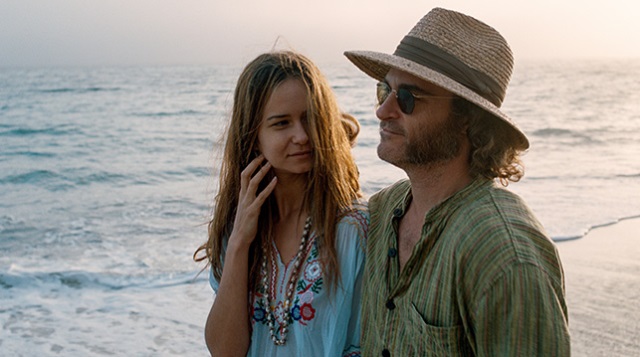
Inherent Vice is Paul Thomas Anderson’s seventh full length film, based on Thomas Pynchon’s seventh novel (published in 2009). But no Pynchon novel has ever been adapted for film; his early-career 1960’s and early 1970’s trifecta (V., The Crying of Lot 49, and Gravity’s Rainbow) are absolute classics of counterculture literature, but they and his later works were resistant to adaptation. PTA has pulled it off, creating a film parallel of Pynchon’s shambolic prose and outrageously-named side characters (though several of these have apparently been lost in the transition). The redoubtable Joaquin Phoenix plays “Doc” Sportello, a P.I. in a California beach town in 1970, who in time-honored film noir fashion is brought a confusing missing person case which twists bewilderingly through endless leads and complications until by the end it’s well-nigh impossible to tell if the bad guys were caught or if they weren’t the good guys all along. People who are complaining that they don’t understand the plot have clearly never watched noir; in the ur-noir The Big Sleep, with Bogie and Bacall, original writer Raymond Chandler famously told the screenwriters that he didn’t actually understand what was happening in the novel he himself had written. The best films noir similarly have a feeling of having gone off the rails as soon as the detective is on the case, with each followed lead pointing to yet another character with another murky motivation. (Also, in true noir, the lead must have the crap kicked out of him at least once and preferably over and over again.)


There have been other neo-modern, California-based, humorous, “sunny” films noir, and lots of critics bring them up as points of comparison, with Altman’s The Long Goodbye and the Coen brothers’ The Big Lebowski being the most obvious; these are fantastic movies in their own rights, but Inherent Vice is something very different. Long Goodbye’s primary hook is the 1940’s-detective-taken-out-of-his-time angle, Philip Marlowe going to sleep as Bogart and waking up in hippie-dippie L.A. and in Elliott Gould’s schlumpy body. Lebowski is the Coen’s reworking of the Bogart film’s beats into a 1990’s context, where Jeff Bridges’ reluctant Everydude is dragged through each noir step against his will. In Vice, Phoenix is a good detective; people around him are offbeat oddballs, but there’s nothing sloppy about the way he conducts his investigation. The missing person case is somehow connected to his great past love, played by Katherine Waterston; plenty of other friends and acquaintances are willing to assist him and despite the straight world’s distaste for his shaggy ways, he is able to gain access to the contacts and crime scenes he needs. The key to Vice is Phoenix’s relationship with his terminally grumpy frenemy counterpart in the straight world, Josh Brolin’s Lieutenant  Detective Christian F. Bjornsen, or "Bigfoot." Brolin is at odds with Phoenix and everything he stands for, and yet they can meet halfway in their collaboration to find answers — and, in fact, by the end Brolin has gone farther than Phoenix has in his attempt to understand the other’s viewpoint.  


Reminds me of:


Like Winterbottom’s Tristram Shandy (from the book by Sterne), Gilliam’s Fear and Loathing in Las Vegas (Thompson), or Kubrick’s Lolita (Nabokov), this was another one of those “unfilmable author/unfilmable novel” projects for which the filmmaker has been given enough support (and taken a sufficiently large step back from the source material) to create a workable film version. In each case, the adapters have had to come up with new filmic structures and elements which somehow capture unique aspects of the written work. I’m not attempting in this short essay to tease out all the ways that Anderson (brilliantly, in my opinion) accomplishes this, because I’m going to need to own the film and watch it a bunch more times for that. But the most obvious modification (and the one remarked upon by every reviewer — I’m not claiming any insight here) is the selection of Doc’s old friend Sortilège as the voiceover narrator and the casting of singer/songwriter Joanna Newsom to play her. She’s not supposed to be a reliable narrator at all, but she serves at least two irremovable functions: she acts as a welcoming, pleasing connection into Phoenix’s world, giving us some empathy and understanding for his character without having to directly introduce Doc’s own voice, and of course she allows Anderson to bring in a huge dollop of Pynchon’s writing. Voiceover narration in a film is almost always a bad idea — but in adaptations of work where the author has a very distinct voice, and where that voice acts as a character of its own in the narrative, narration can be the vital connection between the film and the page. (This doesn’t matter if the written work is plot-driven or if the characters themselves speak to each other in distinct voices. But imagine Clockwork Orange without the pages and pages of Burgess text that Kubrick allows Malcolm McDowell to read in voiceover.) Perhaps the similarity between all of these positive examples is that unreliable narrator — narration as a character, where we’re asked to evaluate its motivations and truthfulness just as we study actions onscreen and suss out what they say about internal states. Some books are clearly going to lend themselves to that treatment, and here Anderson’s smart idea to is not let Phoenix have a Doc Sportello V.O. — forcing us to interpret his actions and reactions — while allowing Newsom’s soothing voice to keep us engaged.


But then — the guilt!


I am a massive, colossal, irredeemable, unapologetic, unmitigated fanatic for PTA. He and the other Anderson are my favorite working guilty-pleasure filmmakers. Until they start blowing it — i.e., until never, per their track record so far — I am going to be in the cinema seat for the premiere week of their new movies, and I am not going to be sitting there in critical or questioning or snarky mode — I am going to be sitting there in a receptive state, waiting to see what they have brought to show me, expecting to be told something new, and if I’m not instantly gratified by some easy, crowd-pleasing fluff, I’m going to be working harder to understand what they say, not going away feeling like they failed. This is my unashamed statement of fact. Thank the heavens above that I am not a "critic" and that these aren’t “reviews.”


I’ve mentioned a number of films based on book above — Lolita, Tristram Shandy, Clockwork Orange and so on — but whereas I’ve actually read all those books, the truth is I’ve never read a word of Pynchon, not Inherent Vice nor any other. I’ve always intended to read them, especially The Crying of Lot 49, which is one of those sort of books that was so spiritually akin to all the books/music/films I did read/hear/watch that I find myself in that weird pop-culture position of being able to grok references to things like Silent Tristero’s Empire (W.A.S.T.E.) or the Yoyodyne Corporation despite never having actually read the source.


Pitch:


At the risk of seeming purely prurient, the lengthy single-take scene which moves from a key Phoenix/Watterson conversation into and through their . . . spirited lovemaking is an acting miracle. Maybe I’ll have a different feeling after I’ve seen the movie a few more times, but in the theater I was holding my breath.


*For movies and shows which are current — in theaters or streaming — I'm posting a short, less-spoilery take on #WhatThomWatched (and generally only when something really strikes me as worth passing on). These shorter essays are labeled Glance.


11 January 2015

#WTW Glance: The Imitation Game

#WhatThomWatched Glance*: 


The Imitation Game


(Morten Tyldum, 2014; In theaters/Disc release details not yet announced)


Recommended for: People interested in cryptography, and/or World War II, and/or British biopics — and/or Benedict Cumberbatch.)

Although there have been a couple high-profile movie treatments of seminal cryptographer and father of the modern computer Alan Turing (most notably Breaking the Code from 1996, with Derek Jacobi as Turing, and based on the same source material), The Imitation Game is really the first attempt to fully address both Turing’s contributions to World War II and his illicit life as a gay man in 1940’s England. Benedict Cumberbatch excels at portraying Turing’s social awkwardness and preternatural intelligence alike; there are also excellent roles for his real-life codebreaking team at Bletchley Park including Keira Knightley as a mathematician determined to operate outside the societal restraints imposed on women. It’s handsomely produced, intelligently written, and well-paced, but beyond being a simple prestige picture it also shows a very specific and shameful example of historical intolerance for homosexuality, in a clear and straightforward way.


Reminds me of:


Other well-made British-cast British-subject biopics — though I don’t usually get into “standard” biopics over the new-school versions from directors like Michael Winterbottom, who seem determined to upend conventions (cf. his depictions of Tony Wilson in 24 Hour Party People, or Mariane and Daniel Pearl in A Mighty Heart). This one has a few of the trite, old melodrama beats and is not terribly faithful to the historical Turing. But I was still impressed at the larger statement it was able to make about Turing’s sexual preference and the way his work could stand in more than one metaphorical way for his personhood and his struggles. I’m pleased to read about scholarship which indicates that his actual life may not have been nearly as abject as what we see here, but at the same time Tyldum and screenwriter Graham Moore have made creative choices which allow Turing to represent much more than just himself; after all, as we learn from a post-film credit, 49,000 other people in Britain were also convicted of gross indecency. The Turing Test is a powerful metaphor for the coded lives these men and women had to lead.


As it happens, in my ongoing (and slow) quest to read everything by Neal Stephenson, I’d recently finished his excellent Cryptonomicon from 1999. This semi-historical novel includes several real Bletchley Park (and rival) codebreakers, among them a far cheerier rendition of Turing. Stephenson also goes light years beyond the complications presented in this film; the final stage of Imitation Game, where the disinformation campaigns begin to kick into gear, is the starting point of the book which (in addition to loads more guns, sex, and haiku) has a much higher level of complexity. For anyone primarily interested in the cryptography problems of advanced warfare, I recommend Stephenson.


But then — the guilt!


As effective as it may be, the movie's still not the accurate story of what happened or what Turing or the Bletchley Park crew did. Showing “science” (or any higher-order creativity) on-screen in ways that audiences respond to is really hard. But as viewers, we should continue to push filmmakers and other artists to do the work and turn these concepts into forms that we can experience and understand. The movie that somehow manages to embody the actual innovative leaps of a Turing (or an Einstein, or a Van Gogh, or a Mozart) and make an audience feel them will be a marvel. (I put this in the BTTG section because I can't readily think of a successful example. Chaim Potok's My Name is Asher Lev is the best parallel I can come up with; in that case a book somehow fully embodies and passes on to the reader the experience of painting, in three incredible pages. I haven’t seen Ed Harris’s Pollock — maybe that captures a similar creative moment in cinematic form? Well, if a movie example comes to me, I won't cheat and edit out my admissions here — I'll post it below in the comments. Feel free to contribute your own!)

Pitch:


Knightley and Cumberbatch's scene together where she denounces his clumsy attempts to push her away is an impressive one — she’s doing a lot of emotional work with a small set of lines.

*For movies and shows which are current — in theaters or streaming — I'm posting a short, less-spoilery take on #WhatThomWatched (and generally only when something really strikes me as worth passing on). These shorter essays are labeled Glance.


10 January 2015

#WTW Glance: Into the Woods

#WhatThomWatched Glance*: 

Into the Woods

(Rob Marshall, 2014; In theaters/Disc release announced for 24 March 2015, Disney Studios)


Recommended for: Those enamored (or potentially enamored) of Sondheim (but not so enamored that a neutered version of one of his greatest works will bother them) . . . .


Fairy tale deconstruction has probably been around as long as the fairy tales themselves. The Washington Post just reviewed new fairy tale books which include the first two entries in a Princeton reprint series called “Oddly Modern Fairy Tales” originally published in the 1920’s and 30’s; these are two of many examples of post-modern takes on the Mother Goose versions from the 1700’s, and they’re coming on a hundred years old themselves. After Disney did The Three Little Pigs mostly straight in 1933 (winning the animated short Oscar and adding “Who’s Afraid of the Big Bad Wolf?” to the lexicon), Warners responded with parody versions: 1943’s Pigs in a Polka, 1953’s The Three Little Pups, 1957’s The Three Little Bops and so on; the trend continued through Jay Ward and Bill Scott (television’s Fractured Fairy Tales), writers like William Steig (Shrek) or Jon Scieszka (The Stinky Cheese Man), and even Disney parodying themselves (in 2007’s Enchanted). These examples are all more or less satirical of the form.


When Sondheim and his collaborator James Levine created Into the Woods in 1986, they were going for something more than parody or pastiche. When they weave the storylines and material from several fairy tales together, they are honoring the form. They take domestic and childhood themes — family, both finding and losing it; children obeying or disobeying or breaking away; what “happy ever after” would actually imply — and express them for adults, in a sophisticated way. There’s certainly ironic humor — for example, as the narrator matter-of-factly describes the birds which peck Cinderella’s mean stepsisters’ eyes out — but the events are as serious and consequential as anything in Andrew Lang's Fairy Book versions. The result was a celebrated musical which has won awards in several productions.


As a movie translation, Marshall's Into the Woods is solid (but: see below). The cast is uniformly excellent; the sets (with exteriors filmed in England, naturally) are tactile and gorgeous; and as pointed out elsewhere (I noticed it first in Jesse Hassenger’s A.V. Club review) Sondheim's fluid lines force the takes to flow in-camera for long strokes, with none of the staccato cutting that plagues other recent movie musicals (most relevantly, Marshall’s own Nine and Chicago).


Reminds me of:

I’m a Sondheim fan and I have been fortunate enough to see some of his masterworks in excellent productions — I caught Assassins in Indianapolis in 1993 which (if my memory serves me) was one of the early regional productions in which Sondheim introduced “Something Just Broke”; and Sunday in the Park with George at the Goodman Theater in 1987, where we were proud to consider that we were watching the show mere yards from the actual Seurat "Sunday Afternoon on the Island of La Grande Jatte" hanging at the Art Institute of Chicago — but I’ve never seen Woods performed. Compromised or not (whoops; spoilers; again, see below), the music is wonderful and the old “You leave the theater with no tunes you can hum” complaint about modern composition is belied by the fact that I caught myself belting out “Into the woods!”, compulsively, days later. (Uh, not that I had much follow-up.)


But then, the guilt!

So, finally, here’s the rub — and the issue which has had Woods fans up a tree about this screen adaptation: A thespian friend of mine, one who was in a production of Into the Woods, has clued me into the differences between the original musical and the movie, starting with the fact that the character he played on stage was cut completely. I had already told him that I loved the music and was generally impressed with the book — but that a few second-act unresolved storylines had bothered me; without any hints from him, I had zeroed in on some of the missing dark bits (live characters that should have been dead, dead ones that should have been . . . . less pleasantly dead). The original show’s parts all lock together as a Sondheim show’s parts will do — meaning that sunny, whimsical themes from a first act are repeated as tragedy in the second; here, we have most of the setup and not quite all of the punchline. The stage version also benefits from a Narrator character who engages the audience more directly (as an actor on stage tends to do), and who transitions into an important figure in the stories proper; this entire interplay vanishes from the film. And while a large-screen, literal image can be gorgeous, there are many ways in which a live staging, dependent on innuendo and unseen things, is more visceral: paradoxically, the Disney version suffers where it shows (even a hint) of, say, a giantess (which could only be imagined on stage), and suffers again when it whitewashes the second-act fates of some characters by failing to show their true ends on screen.


On top of that, the most cursory investigation into the original creation and production of the show makes it clear that it was very much a reaction to its time — specifically, to the AIDS crisis which was at its peak in 1986 when the show opened. Actors in early productions were doubled between the first and second act in roles that connected and commented on each other; for example, the Wolf (whose part is over early in the show) comes back as Cinderella’s Prince, drawing a comparison between the beast's and the man’s treatment of women. Child characters (Little Red Riding Hood, Jack) who are played by age-appropriate child actors in the movie were played by adults in most productions, freeing the show to explore much more explicit themes of carnality and sexual threat. This doesn’t mean that a whole-family Disneyfied version of the same material is worthless, but it’s certainly constrained.


And while I’m piling on . . . . Yes, I loved every line of (retained) music and thought the actors did an honorable job — and yet by the end I had to admit to myself that the overall two hours were . . . not particularly exciting. It’s partially my temperament: I’m not terribly interested in seeing “movie stars” take on Broadway roles. Bob Fosse’s Cabaret is still my gold standard for a modern (i.e. post Rodgers-and-Hammerstein) movie adaptation of a stage musical — which largely works, of course, because the songs are naturalistically placed within the context of the stage-within-the-movie, just as songs are placed within performance contexts in his later All That Jazz.


Pitch:

Maybe I'm just still attuned to bratty little girls after #WTW 8's Alice, but I was particularly taken by Lilla Crawford's Little Red Riding Hood and her song I Know Things Now. (Viewing this with the AIDS crisis context in mind renders it that much more effective.)


*For movies and shows which are current — in theaters or streaming — I'm posting a short, less-spoilery take on #WhatThomWatched (and generally only when something really strikes me as worth passing on). These shorter essays are labeled Glance.

23 December 2014

#WTW Glance: Edge of Tomorrow

#WhatThomWatched Glance*:

Edge of Tomorrow (a.k.a. Live Die Repeat)

(Doug Liman, 2014; Streaming/Also available on disc from Warner Bros.)


The original title of this movie, Edge of Tomorrow, is a rare example of a marketing choice that didn’t give enough away (thus the rebranding for the home video market). This post could follow suit and attempt to hide the main conceit, but to do so would only compound this excellent movie’s problem, which was that it was largely overlooked. Via a not-too-shabby sci-fi mechanism, a character (played by Tom Cruise) resets time and jumps back to a specific point when he dies; he’s a doofus with no combat experience at first, but after hundreds of (implied) iterations, he gains not only skills but also the knowledge to progress a little farther on each try — where the enemy is hiding, which is the best path to take, who to trust and not to trust, and so on. (Yeah, Einstein — “Just like a video game!”) Thing is, as directed by Doug Liman and scripted by Dante Harper, Christopher McQuarrie and Jez and John-Henry Butterworth (and based on the book All You Need Is Kill by Hiroshi Sakurazaka), Edge of Tomorrow turns out to be more: a damn credible satire of the big-budget explosive-y sludge into which Hollywood (and, increasingly, network television) must mash every story. Okay, it’s not satire at a Starship Troopers level, and the time-travel plot is played straight and has plenty of emotional heft. But there’s a definite current which is poking fun at the need to formulate every action movie as an Xbox first-person-shooter and vice-versa.


Reminds me of:

I really don’t expect less from Liman, who I will always love for Swingers and Go (and for whom I carefully guard my respect via the simple expedient of refusing to view Jumper, for all eternity). He has demonstrated (in movies like The Bourne Identity) that he can do big-budget while still focusing primarily on character. Edge also benefits greatly from Cruise’s comic timing and his willingness to play against his action-hero image; Emily Blunt as another time-jumper brings all of the seriousness and weight and pairs with Cruise beautifully. I am also always pleased to spot Noah Taylor in anything (he plays Dr. Carter, the scientist that Blunt’s character is working with to defeat the bad guys); his childhood character Danny Embling (from John Duigan’s The Year My Voice Broke and Flirting) has always felt like my best friend from another life (you know, the one where I grew up in Australia. And went to boarding school with Taylor. Along with Nicole Kidman and Thandie Newton.) At any rate, I jumped out of my chair when he showed up.


But then — the guilt!

When I look at those box office numbers . . . . yeah, I was one of the many who saw the splody trailer in a theater, ho-hummed at a poster of Cruise in yet another futuristic suit of armor, and at Liman’s name allowed myself the fleeting thought: “Ugh. Jumper.” When I should have thought: “Yay! Swingers!!” 

My bad, Doug. You’re so money and you don’t even know it.


Pitch:

Maybe it’s just me but I get a huge kick out of Brendan Gleeson’s two scenes as General Brigham; first where Cruise ticks him off enough to get shanghaied and sent to the front lines, and later when Cruise returns (many lives down the road and much wiser).


*For movies and shows which are current — in theaters or streaming — I'm posting a short, less-spoilery take on #WhatThomWatched (and generally only when something really strikes me as worth passing on). These shorter essays are labeled Glance.