Showing posts with label FilmNoir. Show all posts

17 January 2015

#WTW: Lost Highway

(#WhatThomWatched number nine, number nine....)

#WTW Lost Highway: Fred

Lost Highway

(David Lynch, 1997; Universal Studios disc)

A David Lynch movie is immune to spoilers, because anything anyone can say about it can’t really spoil the experience of watching it, preferably in the dark, alone with one’s own self-doubt. A viewer’s mind naturally organizes the images and events in a movie in an effort to understand “what really happened”; fascinatingly, in Lost Highway “what really happened” doesn’t really work out any differently even when choosing between two wildly different takes: Perhaps the movie’s events are supernatural, and a character (Bill Pullman as Fred Madison) physically morphs into a second human being (Balthazar Getty as Pete Dayton) — or, at the other extreme, Pullman is the only actual protagonist, and the second act is entirely within his own mind as he refuses to face the reality of what he’s done . . . . In either case, part of the genius of Lynch’s construction is that either interpretation fully works, not to mention interim interpretations, and there’s satisfaction to be derived from any of them. The eerie touches and the surrealist imagery (cabins that explode backwards, a demonic character that can be in many places at once), if taken literally, create a grim and evocative horror piece; but if those bits are put aside as merely internal window-dressing, and the various clues are seen as fractured memories and versions of events in Pullman’s life, a puzzle version of the same raw material emerges. And Lynch choosing to credit that demon as ”Mystery Man” seems to make the idea that he is presenting a mystery to be solved (or at least to hypothesize over) explicit.


#WTW Lost Highway: Fred --

#WTW Lost Highway: -- or Pete?

So, Lynch uses Pullman and Getty to show us two versions of a man — Fred/Pete — matched to two wildly divergent interpretations of a woman, both played by Patricia Arquette: Fred’s wife Renee, and Pete’s lover Alice. If we treat Arquette’s extremes as representational of Fred/Pete’s uncomprehending view of her, we can imagine a real Renee/Alice who is actually in the middle — a person with a bit of a sordid past which Fred/Pete has blown so out of proportion in his mind that he becomes unhinged. Or perhaps Renee/Alice is simply the mild-mannered Renee version, and a psychotic Fred has invented the Alice version out of whole cloth in his mind (along with a matching Pete version of himself) in order to justify a horrific murder. Also doubled, and somehow connected to Renee/Alice’s past (which is either Renee’s one-time mistake or Alice’s pervasive and hidden evil side), is the brutal character played by Robert Loggia and called Dick Laurent in Fred’s world and Mr. Eddy in Pete’s; he is a bad man in either of Fred’s interpretations of Renee/Alice (either victimizing her or in cahoots with her). If Renee is an innocent, then nothing that happens in the Alice (second) story is necessarily real; Fred has invented Pete to reinvent himself as the victim: younger, weaker (though perversely more sexually potent), a naïf who is goggle-eyed by the violence of Mr. Eddy and his goons. (Does the “lost highway” represent a road, however twisted, which connects these events into a logical narrative, or would do so if it could be followed?)

#WTW Lost Highway: Mystery

#WTW Lost Highway: Gun

#WTW Lost Highway: Guns


The look, sound and tone of the film are tightly controlled. There’s plenty of violence and a few jump-scare cuts, but as always Lynch is more interested in making what should be the most innocuous actions, gestures and lines supremely creepy. Robert Blake (as the devil-figure Mystery Man) is terrifying simply by dint of a makeup job that renders his face eerily colorless, and wide-open eyes that never blink. Guns that protrude from off-screen suggest that there’s a faceless menace that threatens the characters from all around, as do the windows and skylights in Fred’s apartment which are nervously examined for signs of forced entry. These themes come together in Blake’s use of a video camera (anachronistic now but more bizarrely off-putting because of that) as a threat both as an implement he wields and in the static-filled videotapes he sends to Pullman and Arquette which voyeuristically show them sleeping. And Lynch is masterful in his use of darkness and vertical barriers that split the screen top to bottom to form claustrophobic pockets; again this happens most often in the apartment, trapping Pullman’s character in light that still fails to fully illuminate him.


#WTW Lost Highway: Trapped

#WTW Lost Highway: Trapped

#WTW Lost Highway: Trapped

Reminds me of:

Given that this is the first film in a loose, thematically connected work that Lynch calls his Hollywood Trilogy, it’s worth asking if this entry says anything in particular about the Valley (or the film business) other than just using it as a setting. There’s no question that Lynch and production designer Patricia Norris capture the dry, washed-out feel of Southern California, and a car chase in the hills that ends in violence shows off the terrain, the Angelenos second skin (their automobiles), and the Hollywood sign to boot. Characters and events cover some typical terrain as well: slick parties in nouveau riche decor stuffed with beautiful people, or darker meetings in these same rooms with slimy men and desperate, exploitable actresses. But that’s all surface: Lynch’s two main characters and their dual aspects apiece also say something about acting, about people we pretend to be and whether or not we accept others at face value or suspect that they, too, are hiding their true selves. The Fred/Pete “character” had to be played by two actors, somewhat similar visually (enough to be accepted as one person) but distinct in very clear ways as well (age/potency being the most obvious). The Renee/Alice “character,” in contrast, is played by one actress, possibly lending support to the idea above that her two sides really represent two extreme (and external) views of the same actual person, two warring misinterpretations of the same evidence as parsed by an observer. All of this plays to what happens in Hollywood all the time, the business of the movies, and of how we as audience accept (or not) the characters we see, even to the extreme of burying our own shame and revulsion and projecting our worst selves onto pop culture, both movie roles and the actors themselves. I’m not sure I’ve uncovered anything interesting or true in these guesses, but when I get around to (re)-watching Mulholland Drive and (for the first time) watching Inland Empire, I’ll revisit this exercise and see if there aren’t some similar themes.

#WTW Lost Highway: Fred

#WTW Lost Highway: Pete


Whole transitions between scenes read exactly like snippets of of early avant-garde film experiments, like something from Rien Que Les Heures by Cavalcanti, or Le Retour á la Raison by Man Ray. The enigmatic final few seconds (of Fred driving on the “lost highway”) inspired me to walk through them frame-by-frame, just to see how Lynch had constructed it to invoke maximum unease. Each frame has clearly been carefully composed and selected, and watching it this way only deepened the final mystery for me — it opened up even more questions. This scene and others (such as the torn-away, impressionist frames of the bloody bedroom) are masterpieces of implication, microseconds-long works of art.

#WTW Lost Highway: Videotape

It was also hard not to compare the inciting incident of this film — mysterious videotapes, arriving anonymously in the mail, that appear to show surveillance of the characters’ home — with Michael Haneke’s devastating Caché, which begins the same way.

But then — the guilt!

This is a strong role for Arquette, up for awards this season with her decade-spanning role in Richard Linklater’s Boyhood. Lynch creates a rich and complex dual-extremes-of-Woman character, but of course it’s difficult to watch her be so passively submissive and sexualized as Renee, and then so evilly duplicitous and sexualized as Alice — two pernicious clichés of a male’s sexist view, which of course is exactly the point. Arquette does a phenomenal job but that doesn’t make it any less uncomfortable.

#WTW Lost Highway: Renee


#WTW Lost Highway: Titles


The opening credits — rolling against a rushing highway — are clearly connected to the openings of Ulmer’s Detour and of Aldrich’s Kiss Me Deadly, both dark and perverse films noir that Lynch must be evoking. (This winds up in the BTTG section because, I’m ashamed to admit, I’ve never seen Detour. Kiss Me Deadly, yeah, several times, and I’ll gladly watch it again for a #WTW one of these days, but that doesn’t excuse the other.)  

Pitch:

There’s so much more here than I can possibly work with in a blog post, not to mention so much that I’m not smart enough to understand. Lynch really isn’t for everyone and this movie is particularly prickly and unpleasant. But his ability to create something that invites interpretation and rewards close viewing makes me grateful for the experience, and kept me mulling over it all for weeks. If you’re similarly inclined, you won’t need a pitch.


#WTW Lost Highway: Watch.


28 December 2014

#WTW: Shallow Grave

(#WhatThomWatched seven....)


Shallow Grave

(Danny Boyle, 1994; Criterion spine 616)


#WTW Shallow Grave: MatesThe three primary characters in Shallow Grave, the great Danny Boyle’s (and writer John Hodge’s) first theatrical film, are as unlikable as they come; many read Ewan McGregor’s character as having earned some kind of redemption at the end, but the alternative view that each horrible flatmate deserves exactly what he or she gets (or doesn’t get) seems most credible (people may simply be seduced by McGregor’s laughing blue eyes, and who can blame them?) Boyle’s deployment of minimal resources deserves to be studied as an exemplar of how low-budget can be stylish to a fault. The taut 90-minute story is as simple as can be: three young professional friends take in a fourth roomer who immediately turns up dead, leaving a suitcase of cash. How the friends deal with the body, the money, and each other comprises the rest of the film. You fully expect alliances to form and shift, and some players to be more mentally and emotionally capable than others, but the actual paths those shifts take is unpredictable and exciting. Loud, splashy events occur, as both police and a terrifying pair of remorseless killers close in on the money, but it’s equally rewarding to follow the adjusting mental states of the friends when paranoia sets in, visible through their narrowing eyes and behind their tight expressions.


#WTW Shallow Grave: Color

#WTW Shallow Grave: The reveal


Reminds me of:


#WTW Shallow Grave: Phantom ride
Trainspotting, inevitably; that crawling troll doll (first in the overindulgence montage and later in McGregor’s nightmares) seems directly transported to Renton’s drug trips and a similar baby doll. And having recently watched the Mark Cousins documentary series The Story of Film, my antennae were up for the opening “phantom ride” shots; sped-up footage from a camera mounted on a car streaking through Edinburgh, evoking something out-of-control that might be going on behind the staid rows of Scottish flats. It’s a striking touch that doesn’t immediately connect to the following scene — turns out the rider is just a nice boring bloke who is answering an ad for a room — but once we begin to understand the sick game that our three heroes are playing with him (and many other hopefuls), the visual starts to make sense.


#WTW Shallow Grave: Game


Speaking of visual connections — albeit ones that are clearly coincidental and specific to #WTW! — having just posted images for Youth of the Beast, I couldn’t help but notice scenes with Kerry Fox that evoked it, both the tower of champagne glasses and (more viciously) the point of her black shoe threateningly pushing on McGregor’s chest after he’s fallen on the dance floor — of course that move is aggressively seductive in Grave, but the unintended echo left it tasting perverse and violent.

#WTW Shallow Grave: Youth?

#WTW Shallow Grave: Beast?


(And to give the final actor in the trio his (geek-out) due: Christopher Eccleston is phenomenal here as an easily damaged milquetoast . . . . and, yes, it had to come out sooner or later — I’m a Doctor Who fan (both old and Nu), and Eccleston is far and above my favorite Doctor of the modern series.)
#WTW Shallow Grave: Not a sonic.


But also — the guilt!

I don’t like (or get) Slumdog Millionaire, or at least I didn’t when it came out — maybe I’ll give it another chance, someday, but I’ve got several other Boyle films to see first: Millions, his lightly comedic take on a similar found-money setup; or certainly Sunshine, or last year’s Trance.

There’s some controversy among the fans about the ending — not about its quality, but about whether events occur exactly as shown, or if we’re meant to understand that the literal action is an ironic counterpoint to reality. I must report that Boyle’s commentary on the Criterion disk gives a definitive answer and that it’s not the one I would personally prefer. I’m sure this is my (true?) cynical self coming out, but I prefer a worldview where none of these characters gets an out. I might just choose to read my own implications into the final scene even in the face of authorial intent. (Hmmph; between this and the admission about the Ninth Doctor above I may have just lost half my audience — that’s a whole one of you!)


#WTW Shallow Grave: Things get complicated.
#WTW Shallow Grave: Things get nasty.


#WTW Shallow Grave: Things get sticky.


Pitch:

I get creepy-crawly (in the best way) as McGregor climbs up into the unfinished attic space and we see what Eccelston and his efforts have wrought there — I won’t spoil it with a picture. Is it strictly realistic? I don’t think it is, or has to be. To me it’s a perfect example of art direction used to create a film image in service to the story (and to the mental states of its characters) without necessarily being literal. One thing is sure — more movies should pay this much attention to their look.


19 December 2014

#WTW: Youth of the Beast


(#WhatThomWatched numbah five)


#WTW Youth of the Beast: Jô in trouble

Youth of the Beast (Yajû no seishun)

(Seijun Suzuki, 1963; Criterion spine 268)


So from 1958 through 1963, in five years, Seijun Suziki had made at least 25 features, one after the other, which were more or less straight-up noir and standard genre police-procedurals. And then, with Youth of the Beast, he went utterly bonkers. It’s all the more fantastic for being announced in such an obvious way: the film begins in old-school fifties mode, with a static long shot of curious crowds gathering (though the green titles over the black-and-white are a clear indication that something is up). Police investigators pull a shade to shut the gawkers out of the room where two bodies are lying. After some quick dialogue scenes that could have come from any of the previous films, there’s a cut to a still life of items on a dresser; pills, booze — with one flower, seemingly pasted right in from a different reality, a shocking red . . . . and then the movie takes off in blazing color, and never slows down.

#WTW Youth of the Beast: Black and white...
#WTW Youth of the Beast: ...transition...
#WTW Youth of the Beast: ...color!

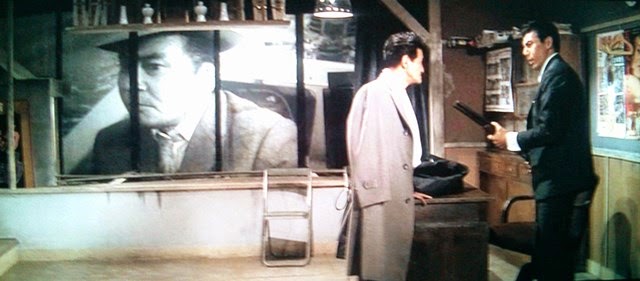
Just a film or two away, Suziki’s crazed compositions would not need to be motivated by any logic, but here there are the flimsiest justifications: One of the rival yazuka mobs has tricked out their sexy nightclub with walls of one-way glass, even the floors, to allow for a shot of a confrontation from below; meanwhile, the other gang does their business in a theater, so that entire scenes of this movie play out in front of a giant screen showing scenes from older crime movies. When an unfortunate junkie is reduced to screaming and begging for her heroin fix, she not only somersaults off a landing, but we see hallucinations of her tormentors from her point of view.

#WTW Youth of the Beast: Frame from below

#WTW Youth of the Beast: Frames behind
And so on and on: Story elements that are otherwise simple are made outrageous by visual detail and/or by choice of incident. Our anti-hero is a hard man who’s out to be hired by one of the mobs, and we need to know how hard he is, so we meet him instigating a street brawl, knocking a man down, kicking him senseless and bloody — and then carefully wiping his shoes off on the man’s white shirt. Or, sent to parley with a rival of his new boss and finding him unwilling to listen, he wordlessly, casually, lights the man’s hair on fire.

#WTW Youth of the Beast: Bloody shoes

#WTW Youth of the Beast: Fire

The jazz score is excellent. Some of the pulpy choices, of course, aren’t politically correct to us today, but at least they evoke the classical clichés: every dame is two-timing (if she’s not a pervert’s victim), the loyal thug is as slow as a box of hammers, and the sickest sadist of all is, naturally, a homosexual — but no one would mistake this flick for social realism. It's fun, fun from first frame to last, slick, outrageous fun.


Reminds me of: 

According to Katherine Rife’s If You Like Quentin Tarantino…. (and her 2013 interview with DailyGrindhouse.com), Tarantino denies any Suziki influence (though neither she nor interviewer King B are convinced: “...he says he’s not, but he totally was.”) The mid-sixties Suzukis, especially Branded to Kill, have some clear parallels in movies like Kill Bill — though the chop-socky, early-seventies exploitation films are perhaps more direct precursors. I’ve seen about half of the available Criterion Suzukis — BrandedTokyo DrifterTake Aim At the Police Van — with a couple more purchased and ready to spin: Gate of FleshFighting Elegy. As mentioned before, his later films don’t need any excuse to slip into impressionistic and associative images, like the butterfly graphics that suffuse Branded

#WTW Youth of the Beast: Multiples

I also was struck a couple times with a thought that I’ve only ever had while watching Kurosawa: both men have a real knack for wide compositions that incorporate large groups of people, often ten, fifteen men scattered throughout the frame, each seeming to pull the viewer’s focus one direction or another. For instance, the first half of The Bad Sleep Well is largely set in the industrialist’s mansion, and a huge crowd of people are in the room at any one moment, usually all visible in the frame, like a version of The Last Supper but with ever-shifting figures and interrelationships. Or in Sanjuro, where Mifune is trailed by a snaking line of samurai followers through several scenes. In Youth, it’s most notable in a scene in the Sanko Mob’s hideout, where at least ten heavies are in the room. Maybe it’s a particularly Japanese style; I’ll have to keep an eye out.

#WTW Youth of the Beast: Style

But also — the guilt! 

Well, there’s those thirty-odd more Suzukis to see! But seriously, with so many of my contemporary film enthusiasts into Japanese genre flicks, I’ll always be hopelessly behind. I will state that I have gone gaga for several other Japanese directors and films, some from the Criterion collection (including Hiroshi Teshigahara, Nobuhiko Ôbayashi’s House, the 25 Zatoichi films) and some from dedicated distributors like AnimEgo (Lone Wolf and Cub, the Sleepy Eyes of Death series) — so many more #WTWs are in the cards. But a year or two’s worth of backlog doesn’t begin to even scratch the surface of amazing Japanese cinema.

And: I honestly do not understand what the English title is supposed to mean. Youth? Beast? Other than “Hey, it’s the Sixties and the wacky kids with their crazy and it’s kooky and we straights are scared of them” (which certainly has its parallels in Hollywood — Psych-OutLady in a CageThe Wild Angels, etc. etc.), I can’t really suss it out. Maybe it’s just a too-literal translation of a more nuanced Japanese idiom in its original title Yajû no seishun. IMDb also lists Wild Youth as an alternate English translation. Anyone have other ideas? 


#WTW Youth of the Beast: Evil cat trope


Pitch: 

Scene after scene after scene presents new visionary delights; I’ll start the pitch right at Joe Shishido’s early entrance (technically, his pointy shoes’ entrance) right through his jaded act at the Nomoto club, as he drags you into the movie beat by beat. And then  it never lets up. If I didn’t worry about my brain exploding, I’d want to put in another Suzuki movie as soon as the final scene rolls on the one before.

12 December 2014

#WTW: The Killing

(#WhatThomWatched IV)

#WTW The Killing: Masked


The Killing 

(Stanley Kubrick, 1956; Criterion spine 575)


The film begins with grainy stock footage of a track; the horses are led from the stables, the starting gate is pulled into position, a flat-voiced announcer (represented by a static shot of the loudspeaker horn on a pole)  blares out race information. And then a second, stentorian voice begins to reel off details, times, places, character names. It’s late-era film noir and we are being introduced to the primary players in a heist operation, but something seems strange: with each new character and situation that’s introduced , the time of day given runs backwards. More stock footage sets up locations or can be seen in process shots outside windows of rooms, or integrated behind newly filmed action -- and then we see the gang’s mastermind, Johnny Clay (Sterling Hayden), side-on, talking to his girl and striding stage left through a railway apartment, room after room after room, as the the camera smoothly pans with him for the entire length -- a shot that’s pure Kubrick, used to devastating effect in the trench scenes in the next year’s Paths of Glory. And then, having been introduced to too many characters to follow . . . the horses are led from the stables, the starting gate is pulled into position, and the flat-voiced announcer and stentorian narration start up again as another detail of the plot is revealed. Hayden has a convoluted plan in his head and he’s the only one allowed to know how all the pieces fit together; truthfully, it’s not even clear that the narrator has all his facts straight. As with all the best noirs, the coherence of the plan is less important than the endless doors opening and closing, the locking and unlocking and relocking of lockers and cases, the parcels carried, suit jackets hung, rifles carefully aimed, and, at the epicenter of tension, the ugly misshapen rubber hobo mask pulled down over Hayden’s head. He lines up his temporary hostages in the track’s business office, like the lined-up policeman targets at his rifleman’s makeshift range, and dust motes float through the air of the hideouts and the walkups like leaves in the wind. Or money.

#WTW The Killing: Target range


#WTW The Killing: Chess


Reminds me of

Although filmed in California, the portrait-like black-and-white shots of city streets and gaming parlors make me think of the Manhattan of Sweet Smell of Success, or the Greenwich Village of Scarlet Street. Lots of people notice the real-world strip club that advertises their headliner Lenny Bruce (shades of Fosse’s Lenny, or its fictitious beard Stand-Up in All That Jazz). And of course, a defining noir trait is the complexity of the plot; my first in-depth experience with the genre was Hawks’s The Big Sleep, which Raymond Chandler famously said he couldn’t follow even though he wrote it. (I am certain that Chandler is going to come up again in #WTW, since early in my collecting years I set myself the task of acquiring every film depiction of detective Phil(l)ip Marlow(e), and with the sole exception of Robert Mitchum in Farewell, My Lovely, I have.)

#WTW The Killing: Street


(I have one more RMO item which is too crazy to be detailed here but has been relegated to a footnote below.)


But also — the guilt!

This is the final major Kubrick film which I had not seen; I’ll eventually watch his previous Killer’s Kiss (included on the Criterion disc) but unless it really knocks me out, I doubt I’ll document it — it’s just my fetish for completism driving me. Where I really fall down is in the larger noir universe. Despite my aforementioned collection of seven-of-eight major film depictions of Marlowe, there are literally hundreds of important noir films which I haven’t seen, despite the availability of  multiple collections from key studios.


#WTW The Killing: Elisha Cook and Marie Windsor
I also feel guilty that my chosen format for #WTW means that I’ve left out a long list of all the amazing actors and characters in this movie’s pileup. I especially love Sherry Peatty and her bullied-by-everyone husband George (Marie Windsor and Elisha Cook), who at least made it into the illustrative photos.


And: I will put in my vote that the film’s title is an ironic reference to the big score that the conspirators are expecting as reward — their “killing” — and not a reference to anyone, man woman or horse, who might meet an untimely end. But I could be wrong.


Pitch:

The final scene has such a jarring change of tone — all of the meticulous detail and sense of dread is deflated into rotten luck and cruel slapstick comedy. And yet, upon second thought . . . . it’s a brilliant ending. Hayden is the ultimate control freak, pulling every cord and dribbling out the barest minimum of information, and his plan is wound too tightly to succeed.


#WTW The Killing: Dr. Mabuse has me seeing things?
*So I am no DVD Savant — his reviews are so well informed by his years in the industry, thousands of viewed films, and army of equally knowledgeable correspondents — and his ability to spot actors in bit parts awes me. And my obsession with Dr. Mabuse, sure to be detailed in future #WTWs, borders on the insane— I am likely remote-controlled by the evil doctor, with no will of my own. That certainly explains my love for German actor Werner Peters, who everyone else thinks of in evil parts but whom I find cuddly, having been introduced to him in Lang's The 1,000 Eyes of Dr. Mabuse as Hieronymus B. Mistelzweig. What is my point? I am convinced that Werner is standing in front center frame talking animatedly to the airport employee with a clipboard in the single, silent shot at the very end of the movie, next to Lady with Small Dog. If you are a fellow Mabusaphile, see if you agree with me. If not, watch this space for future details of my sickness.