Showing posts with label CrimeFilm. Show all posts

07 February 2015

#WTW: The Friends of Eddie Coyle

(Hoorah, it's an even odd #WhatThomWatched baker's dozen . . .)


#WTW Friends of Eddie Coyle: Another job


The Friends of Eddie Coyle

(1973, Peter Yates; Criterion spine 475)


If a viewer had never seen Robert Mitchum in any other movie, what would they think of him based on this performance? He’s a loser, two-bit, defeated, sort of weasely; once a master safecracker (known as “Fingers”) and yet now with crushed and broken hands, working the outside edges of his remaining underworld contacts, acting as a middleman to supply hoods with the one-time-use guns they need to pull their bank jobs. He talks (and talks) a good game — well, he thinks he does; he pushes an old-timer tough-guy act on his young supplier (who’s just another middleman farther down the chain); he hangs around his former haunts in an attempt to stay in touch; and, most critically, he tries to build himself up into a position of relevance to an undercover agent in an effort to clear himself of a jail sentence. It’s at least one too many “friends” to balance. 

#WTW Friends of Eddie Coyle: Eddie

Meanwhile, the movie shows a kind of grim 1970’s Boston that isn’t usually depicted in a crime movie — instead of a vibrant city or even a grimy one, there’s rundown suburban spaces, with clandestine meetings in endless sad parks, remote train platforms, faceless parking lots, and after-hours gravel pits. There’s a running visual theme of men in cars spying on events in the street and on each other, and then when they meet to talk in person, they talk about cars. (The payoff to that one is Peter Boyle’s bartender character, who holds some central locus of information and power in the underworld’s matrix but doesn’t know how to drive.)
#WTW Friends of Eddie Coyle: Car

#WTW Friends of Eddie Coyle: Car

#WTW Friends of Eddie Coyle: Car

#WTW Friends of Eddie Coyle: Car

#WTW Friends of Eddie Coyle: Car

#WTW Friends of Eddie Coyle: No car

Eddie Coyle is one of the indisputably great (if oddly overlooked) downbeat movies of the early-1970’s American realism movement, so the audience never expects things to end well. But it has so many grace notes, many of them centered on Mitchum, including his aforementioned attempts to mentor the gunrunner (Stephen Keats), his concern with keeping the heists incident-free if possible, and a simple, touching domestic scene with his wife (Helena Carroll). Mitchum seems to physically shrink into himself as if he’s trying to fade into the background and out of notice; even as it becomes clear that no amount of snitching is going to satisfy Richard Jordan’s agent, he continues to look for a new angle. Whatever loquacious magic allowed him to escape his earlier misadventures with only a set of broken fingers is at its last ebb here. And Mitchum isn’t the only actor at the top of his game: Keats has a mesmerizing magnetism; he’s fantastic to watch. Jordan moves from blandly friendly and jocular into, eventually, chilling disregard. Boyle is as great as always, and so on — there are eight or nine more excellent character actors in the ensemble. They play Eddie’s immediate contacts in an implied, much larger web of criminals and stoolies, encompassing both the savvy and jaded (the three members of the bank heist team, slipping on their new set of one-time masks for the next job like they’re clocking in for their factory shift) and the even younger newbies, the green wanna-bes who are just getting started (the kids selling stolen rifles, the baby-faced couple working out of their windowless van). 

#WTW Friends of Eddie Coyle: Cynical Keats


#WTW Friends of Eddie Coyle: Kids...
#WTW Friends of Eddie Coyle: ...with a plan.


In every instance, and even in the case of the undercover cops, each person seems unwilling to do any more than their tiny piece of work; each wants to be the smallest possible cog in the crime machine. Contrast this with the many movie depictions of criminals (and especially bank robbers) as public figures, vigilantes just as interested in notoriety as cash, who see themselves as avengers of their society’s ill-dealing to them or their class — Bonnie and Clyde, Gun Crazy, Honeymoon Killers, Natural Born Killers. Mitchum’s role as the weapons middleman emphasizes both his unimportance and also the idea of (loosely) organized crime as a kind of bureaucracy; whereas organized organized crime movies (the Godfather trilogy, The Yakuza, Goodfellas, even Youth of the Beast) show the Mafia or the Yakuza as a family and as a societal order which trumps the government’s order. Crime in Eddie Coyle is filled with misinformation, broken contacts, and infiltrations from undercover police who hardly even need informants to make their collars.

#WTW Friends of Eddie Coyle: Time to go to work

Mitchum was an old-time movie star, with plenty of great movies but plenty more where he could just be his big ol’ self up on that screen. (Many of his movies were both.) In The Friends of Eddie Coyle he shows just how superb an actor he really was, creating a one-of-a-kind character among some of the finest character actors of his day. Anyone who thinks that Mitchum was always “playing himself” on screen is dead wrong; Q.E.D.


Reminds me of:


Film scholar and director Kent Jones’ Criterion booklet essay makes the point that no one should mourn the fact that movies like this aren’t made anymore because there are no other movies like it. And it’s true that it is surprisingly difficult to find film parallels to Coyle. There’s no outrageous colors, images or cuts like in a Tarantino or Suzuki crime film. There’s no bloody showdown ending in which, a la Hamlet, various factions mow each other down like in L. A. Confidential or a revisionist Peckinpah (or Eastwood) western. There’s no stylized heightened genre dialog evoking films of another era, like a Coen brothers film or something written by Elmore Leonard. If the characters didn’t talk as much as they do, it would be comparable to one of those great French or Swedish films about a character’s world where we watch them go about their business without explanations, like Bresson’s Pickpocket or Bergman’s Wild Strawberries. But Eddie and his friends do talk, with some of the best naturalistic dialog ever, courtesy of George V. Higgins’s source novel.

#WTW Friends of Eddie Coyle: Meetings...

#WTW Friends of Eddie Coyle: ...Talks...

#WTW Friends of Eddie Coyle: ...and Suburbia


The most recent #WTW that involved bank heists was obviously Thieves Like Us; these two films are set in very different eras but are similar in their pared-down approach to showing how the crimes are executed. Both also show a successful job first so that the audience is oriented to the gang’s modus operandi before having subsequent jobs introduce issues. Lumet’s Dog Day Afternoon, with its single, interminable bank job that turns into a siege, is never far from my mind when watching any robbery in a film; there, we have so much time to consider the inner states of the robbers, the bank manager and the employees, and the police that it almost becomes a kind of universal back-story for the terser, usually close to wordless iterations in films like Coyle.


But then — the guilt!


Peter Yates was a British director with a wide range of notable movies including several which, like the Boston of Coyle, embody American towns and regions: Breaking Away, about competitive cyclists in central Indiana, is a great example; there’s also the San Francisco streets of Bullitt, the Los Angeles of the comedy Mother, Jugs & Speed, or the late-sixties New York singles scene of John and Mary. I haven’t seen Breaking Away in twenty years and I’ve never seen the others. (Though one of my favorite films as a kid was his The Hot Rock with Robert Redford, and I own that one. I’ll leave you all to shake your heads sadly at the guy who was first in line to buy The Hot Rock and yet has never seen Bullitt.)


#WTW Friends of Eddie Coyle: Another coffeeshop


Similarly: Mitchum was a highly prolific actor. I’ve got some choice Mitchum in my collection: will likely have to double-dip someday and pick up another (the Criterion) copy of the amazing The Night of the Hunter, and I have one of his two turns as Phillip Marlowe in my D-I-Y Marlowe collection (mentioned back in #WTW 4) . . . but there are so many more. He sings in What a Way to Go! (and others), has a drop-dead impressive accent in The Sundowers (Australian) and Ryan’s Daughter (Irish) (and many others!), and can do comedy just as well as he can do tough-guy. His Dick Cavett interview (collected on Shout Factory’s The Dick Cavett Show: Hollywood Greats, sadly out of print) is a fantastic late-career interview for him; he’s funny and smart. So many more Mitchum performances to seek out.


Pitch:


I love every frame of The Friends of Eddie Coyle. (I must not be alone — Stephen Keats’s character is named Jackie Brown, after all.) You’ll know if you’re going to be similarly bewitched after the early scene between Keats and Mitchum where they talk in the first of many coffee-shop conversations: 

“One of us is going to have a big fat problem. And another thing: If anyone is going to have a problem, you’re gonna be the one.”

#WTW Friends of Eddie Coyle: Mitchum


28 December 2014

#WTW: Shallow Grave

(#WhatThomWatched seven....)


Shallow Grave

(Danny Boyle, 1994; Criterion spine 616)


#WTW Shallow Grave: MatesThe three primary characters in Shallow Grave, the great Danny Boyle’s (and writer John Hodge’s) first theatrical film, are as unlikable as they come; many read Ewan McGregor’s character as having earned some kind of redemption at the end, but the alternative view that each horrible flatmate deserves exactly what he or she gets (or doesn’t get) seems most credible (people may simply be seduced by McGregor’s laughing blue eyes, and who can blame them?) Boyle’s deployment of minimal resources deserves to be studied as an exemplar of how low-budget can be stylish to a fault. The taut 90-minute story is as simple as can be: three young professional friends take in a fourth roomer who immediately turns up dead, leaving a suitcase of cash. How the friends deal with the body, the money, and each other comprises the rest of the film. You fully expect alliances to form and shift, and some players to be more mentally and emotionally capable than others, but the actual paths those shifts take is unpredictable and exciting. Loud, splashy events occur, as both police and a terrifying pair of remorseless killers close in on the money, but it’s equally rewarding to follow the adjusting mental states of the friends when paranoia sets in, visible through their narrowing eyes and behind their tight expressions.


#WTW Shallow Grave: Color

#WTW Shallow Grave: The reveal


Reminds me of:


#WTW Shallow Grave: Phantom ride
Trainspotting, inevitably; that crawling troll doll (first in the overindulgence montage and later in McGregor’s nightmares) seems directly transported to Renton’s drug trips and a similar baby doll. And having recently watched the Mark Cousins documentary series The Story of Film, my antennae were up for the opening “phantom ride” shots; sped-up footage from a camera mounted on a car streaking through Edinburgh, evoking something out-of-control that might be going on behind the staid rows of Scottish flats. It’s a striking touch that doesn’t immediately connect to the following scene — turns out the rider is just a nice boring bloke who is answering an ad for a room — but once we begin to understand the sick game that our three heroes are playing with him (and many other hopefuls), the visual starts to make sense.


#WTW Shallow Grave: Game


Speaking of visual connections — albeit ones that are clearly coincidental and specific to #WTW! — having just posted images for Youth of the Beast, I couldn’t help but notice scenes with Kerry Fox that evoked it, both the tower of champagne glasses and (more viciously) the point of her black shoe threateningly pushing on McGregor’s chest after he’s fallen on the dance floor — of course that move is aggressively seductive in Grave, but the unintended echo left it tasting perverse and violent.

#WTW Shallow Grave: Youth?

#WTW Shallow Grave: Beast?


(And to give the final actor in the trio his (geek-out) due: Christopher Eccleston is phenomenal here as an easily damaged milquetoast . . . . and, yes, it had to come out sooner or later — I’m a Doctor Who fan (both old and Nu), and Eccleston is far and above my favorite Doctor of the modern series.)
#WTW Shallow Grave: Not a sonic.


But also — the guilt!

I don’t like (or get) Slumdog Millionaire, or at least I didn’t when it came out — maybe I’ll give it another chance, someday, but I’ve got several other Boyle films to see first: Millions, his lightly comedic take on a similar found-money setup; or certainly Sunshine, or last year’s Trance.

There’s some controversy among the fans about the ending — not about its quality, but about whether events occur exactly as shown, or if we’re meant to understand that the literal action is an ironic counterpoint to reality. I must report that Boyle’s commentary on the Criterion disk gives a definitive answer and that it’s not the one I would personally prefer. I’m sure this is my (true?) cynical self coming out, but I prefer a worldview where none of these characters gets an out. I might just choose to read my own implications into the final scene even in the face of authorial intent. (Hmmph; between this and the admission about the Ninth Doctor above I may have just lost half my audience — that’s a whole one of you!)


#WTW Shallow Grave: Things get complicated.
#WTW Shallow Grave: Things get nasty.


#WTW Shallow Grave: Things get sticky.


Pitch:

I get creepy-crawly (in the best way) as McGregor climbs up into the unfinished attic space and we see what Eccelston and his efforts have wrought there — I won’t spoil it with a picture. Is it strictly realistic? I don’t think it is, or has to be. To me it’s a perfect example of art direction used to create a film image in service to the story (and to the mental states of its characters) without necessarily being literal. One thing is sure — more movies should pay this much attention to their look.


21 December 2014

#WTW: Thieves Like Us

(#WhatThomWatched six!)

#WTW Thieves Like Us: Domestic fantasy


Thieves Like Us


(Robert Altman, 1974; MGM DVD, also available on Blu-Ray)


#WTW Thieves Like Us: Sponsorship
Everyone understands the idea of product placements in movies and television shows, ranging from subtle (corporate logos in 2001: A Space Odyssey) to obnoxious (the McDonald’s-funded Mac and Me, e.g.; Cracked has this one nailed), to knowing self-parody (twenty-odd years ago, Wayne’s World had Mike Myers declaiming “Contract or no, I will not bow to any sponsor!” while holding up a Pizza Hut box). But the constant appearance of Coca-Cola in Thieves Like Us doesn’t feel anything like advertising; instead, it’s just the most obvious textural detail in what might be the best representation of the Depression-era American South in all cinema. Coke is everywhere: advertised on round tin signs at every store, of course, but also sponsoring the State Penitentiary; its familiar bottles grasped by many characters (most often by Shelley Duvall’s Keechie), but also, empty, lined up on mantels and porches; and in one scene, hawked from a vendor’s truck in the town square, with seemingly every kid in the county running up with their nickels. Coke represents an affordable luxury (sometimes just barely so); as such it’s also an actual working part of the Southern economy (again, so slightly; at five cents a pop it can’t fix everything). It’s also a still-current symbol for nostalgia that seems to have always been nostalgic.


#WTW Thieves Like Us: Spot the radio

#WTW Thieves Like Us: The Shadow...

#WTW Thieves Like Us: ...and The Shadow again

Equally ubiquitous in the world of Thieves: radio. Characters listen to the radio for important plot points, of course; our lead Bowie (Keith Carradine) wouldn’t know the fate of his fellow bank robbers without a radio in his car. But radio is fundamental to the 1930’s in every way: it’s in the background of many scenes both audibly and visibly; characters often listen to the same programs from different vantage points or sets, and the radio’s content always comments on the primary action. Most boldly, Altman sometimes allows the stream of radio noise to slip away from realism and into direct dialog with the film’s images; for example, as Keechie and Bowie edge into a physical relationship, a radio dramatization of Romeo and Juliet’s love sonnet plays out and loops back and back again to repeat portions of the dialogue and narration verbatim.

#WTW Thieves Like Us: Carradine

Similarly to many of Altman’s best movies, Thieves Like Us depends less on plot and incident and more on character and tone. Its ending might be its weakest point, since the conventions of a crooks-on-the-run yarn demand that the law must eventually catch up. But in contrast with that possibly purposely brief resolution, the center of the film is gloriously stretched out and extended. Carradine’s character went a bad way when he was impossibly young, just a teenager, and he sees himself as an inevitably bad person even as we (and Duvall’s character) can easily see all of his good. He falls in love with Duvall while laid up in hiding in her barn after an injury, and his weeks of recovery away from his partners and safe from discovery allow the two of them to play out a fantasy, a different life of domesticity for them both. As simple as the idea may be, and as quick as it is to sketch out in words, Altman instead chooses to allow these scenes to go on at length while the world outside seems to stand still, and their new life is allowed to get as far as a little house of their own and future plans apart from Carradine’s criminal past. When the wheel begins to turn again, the viewer is crushingly aware of what the couple will lose. That languorous, idyllic center of the movie is quite literally the pause that refreshes. 


#WTW Thieves Like Us: Waking 1

#WTW Thieves Like Us: Waking 2

#WTW Thieves Like Us: Waking 3

(Hmm — clearly Coke is on my mind.)

Reminds me of: 

For all of his brilliance Altman seems to be polarizing and I am firmly in the pro- camp, as future #WTW postings are sure to prove. There are lots of connections between Thieves and his other work but the most obvious to me is his use of sound here (the endless radio broadcasts, encompassing the news, commercials, “Gang Busters” and other famous serials) akin to M.A.S.H. and the camp’s P.A. announcements, or Nashville and Hal Phillip Walker’s megaphone car. In terms of story, Thieves Like Us obviously bears comparison to Bonnie and Clyde; where Penn’s movie chose to focus on the Barrow Gang’s presage of celebrity culture, and the couple’s fascination with fame, Bowie in Thieves desperately wants to be normal, unknown, the opposite of notorious. He and his co-criminals do scour the newspapers and the airwaves for any mention of their adventures, but — at least for Bowie — it seems more a practicality intended to keep them one step ahead of the police. There’s very little celebration among the outlaws, here; crime isn’t a catalyst for sexuality, as in Gun Crazy, or a shared bond, as in The Honeymoon Killers — it's just necessary for survival.


#WTW Thieves Like Us: Mist

#WTW Thieves Like Us: Plotting

But also — the guilt! 

Among the comparisons I can draw, I can’t compare Altman’s film to the other high-profile movie that was made from the same Edward Anderson source novel, Nicholas Ray’s They Live By Night — I’ve never seen it. I also never watch an Altman without feeling guilty that I don’t watch him more often. His films are fine literature in a world that’s increasingly tuning out for the movie equivalent of tweets and listicles. Hopefully #WTW will shame me into rewatching some of the best — California Split, The Player, McCabe & Mrs. Miller, 3 Women — and also spur me into hunting down some of the ones I’ve never seen — I hear there’s a new-ish release of Brewster McCloud, for instance.


#WTW Thieves Like Us: Injured


Pitch: 

Amongst all the intertwining of the criminal life and run-of-the-mill life in 1937 Mississippi, there’s a brilliant scene where Carradine’s partners (played by John Schuck and Bert Remsen) practice for a bank job with Remsen’s girlfriend and her kid brother playing the bank employees, chairs up on a table to represent teller’s cages, literally a grown-up’s game of make believe. When things go sour in the play-acting version, you can sure bet things won’t be any sweeter in real life.


#WTW Thieves Like Us: Sadder and wiser

19 December 2014

#WTW: Youth of the Beast


(#WhatThomWatched numbah five)


#WTW Youth of the Beast: Jô in trouble

Youth of the Beast (Yajû no seishun)

(Seijun Suzuki, 1963; Criterion spine 268)


So from 1958 through 1963, in five years, Seijun Suziki had made at least 25 features, one after the other, which were more or less straight-up noir and standard genre police-procedurals. And then, with Youth of the Beast, he went utterly bonkers. It’s all the more fantastic for being announced in such an obvious way: the film begins in old-school fifties mode, with a static long shot of curious crowds gathering (though the green titles over the black-and-white are a clear indication that something is up). Police investigators pull a shade to shut the gawkers out of the room where two bodies are lying. After some quick dialogue scenes that could have come from any of the previous films, there’s a cut to a still life of items on a dresser; pills, booze — with one flower, seemingly pasted right in from a different reality, a shocking red . . . . and then the movie takes off in blazing color, and never slows down.

#WTW Youth of the Beast: Black and white...
#WTW Youth of the Beast: ...transition...
#WTW Youth of the Beast: ...color!

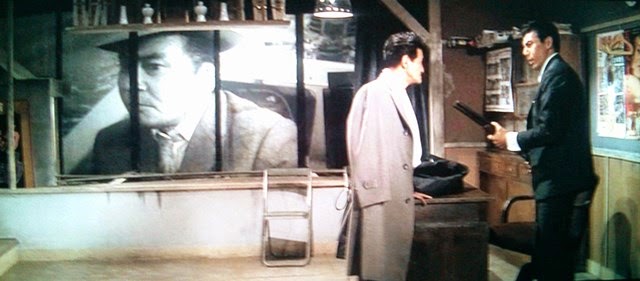
Just a film or two away, Suziki’s crazed compositions would not need to be motivated by any logic, but here there are the flimsiest justifications: One of the rival yazuka mobs has tricked out their sexy nightclub with walls of one-way glass, even the floors, to allow for a shot of a confrontation from below; meanwhile, the other gang does their business in a theater, so that entire scenes of this movie play out in front of a giant screen showing scenes from older crime movies. When an unfortunate junkie is reduced to screaming and begging for her heroin fix, she not only somersaults off a landing, but we see hallucinations of her tormentors from her point of view.

#WTW Youth of the Beast: Frame from below

#WTW Youth of the Beast: Frames behind
And so on and on: Story elements that are otherwise simple are made outrageous by visual detail and/or by choice of incident. Our anti-hero is a hard man who’s out to be hired by one of the mobs, and we need to know how hard he is, so we meet him instigating a street brawl, knocking a man down, kicking him senseless and bloody — and then carefully wiping his shoes off on the man’s white shirt. Or, sent to parley with a rival of his new boss and finding him unwilling to listen, he wordlessly, casually, lights the man’s hair on fire.

#WTW Youth of the Beast: Bloody shoes

#WTW Youth of the Beast: Fire

The jazz score is excellent. Some of the pulpy choices, of course, aren’t politically correct to us today, but at least they evoke the classical clichés: every dame is two-timing (if she’s not a pervert’s victim), the loyal thug is as slow as a box of hammers, and the sickest sadist of all is, naturally, a homosexual — but no one would mistake this flick for social realism. It's fun, fun from first frame to last, slick, outrageous fun.


Reminds me of: 

According to Katherine Rife’s If You Like Quentin Tarantino…. (and her 2013 interview with DailyGrindhouse.com), Tarantino denies any Suziki influence (though neither she nor interviewer King B are convinced: “...he says he’s not, but he totally was.”) The mid-sixties Suzukis, especially Branded to Kill, have some clear parallels in movies like Kill Bill — though the chop-socky, early-seventies exploitation films are perhaps more direct precursors. I’ve seen about half of the available Criterion Suzukis — Branded, Tokyo Drifter, Take Aim At the Police Van — with a couple more purchased and ready to spin: Gate of Flesh, Fighting Elegy. As mentioned before, his later films don’t need any excuse to slip into impressionistic and associative images, like the butterfly graphics that suffuse Branded. 

#WTW Youth of the Beast: Multiples

I also was struck a couple times with a thought that I’ve only ever had while watching Kurosawa: both men have a real knack for wide compositions that incorporate large groups of people, often ten, fifteen men scattered throughout the frame, each seeming to pull the viewer’s focus one direction or another. For instance, the first half of The Bad Sleep Well is largely set in the industrialist’s mansion, and a huge crowd of people are in the room at any one moment, usually all visible in the frame, like a version of The Last Supper but with ever-shifting figures and interrelationships. Or in Sanjuro, where Mifune is trailed by a snaking line of samurai followers through several scenes. In Youth, it’s most notable in a scene in the Sanko Mob’s hideout, where at least ten heavies are in the room. Maybe it’s a particularly Japanese style; I’ll have to keep an eye out.

#WTW Youth of the Beast: Style

But also — the guilt! 

Well, there’s those thirty-odd more Suzukis to see! But seriously, with so many of my contemporary film enthusiasts into Japanese genre flicks, I’ll always be hopelessly behind. I will state that I have gone gaga for several other Japanese directors and films, some from the Criterion collection (including Hiroshi Teshigahara, Nobuhiko Ôbayashi’s House, the 25 Zatoichi films) and some from dedicated distributors like AnimEgo (Lone Wolf and Cub, the Sleepy Eyes of Death series) — so many more #WTWs are in the cards. But a year or two’s worth of backlog doesn’t begin to even scratch the surface of amazing Japanese cinema.

And: I honestly do not understand what the English title is supposed to mean. Youth? Beast? Other than “Hey, it’s the Sixties and the wacky kids with their crazy and it’s kooky and we straights are scared of them” (which certainly has its parallels in Hollywood — Psych-Out, Lady in a Cage, The Wild Angels, etc. etc.), I can’t really suss it out. Maybe it’s just a too-literal translation of a more nuanced Japanese idiom in its original title Yajû no seishun. IMDb also lists Wild Youth as an alternate English translation. Anyone have other ideas? 


#WTW Youth of the Beast: Evil cat trope


Pitch: 

Scene after scene after scene presents new visionary delights; I’ll start the pitch right at Joe Shishido’s early entrance (technically, his pointy shoes’ entrance) right through his jaded act at the Nomoto club, as he drags you into the movie beat by beat. And then  it never lets up. If I didn’t worry about my brain exploding, I’d want to put in another Suzuki movie as soon as the final scene rolls on the one before.