Showing posts with label 1970s. Show all posts

18 April 2015

#WTW: Phantom of the Paradise

(#WhatThomWatched spooky-scary #23)

#WTW: Phantom of the Paradise

Phantom of the Paradise

(1974, Brian De Palma; Shout! Factory disk)


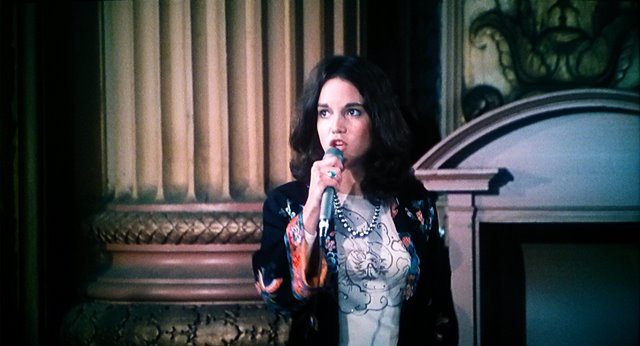
By rights, Brian De Palma’s horror/comedy/musical should be at least as famous as The Rocky Horror Picture Show, which was gestating at the same time, but Phantom of the Paradise was plagued by horrible luck when it opened in 1974. As detailed in the 2006 French documentary Paradise Regained (included on the recent Scream Factory release), the film was hit with no fewer than four lawsuits in the days just after post-production wrapped, seriously hampering its release: Universal called the film an infringement on the Lon Chaney Phantom of the Opera from 1925; King Features sued as the owners of the comic book character “The Phantom”; the manager of a rock frontman who had been tragically electrocuted onstage in a manner uncomfortably close to a comic death in the film sued for defamation (not named in the docu, but most likely Peter Grant, manager of Stone the Crows guitarist Les Harvey, killed in 1972); and, most damaging to to De Palma’s intricately crafted production design, Led Zeppelin. Their record label had just been registered as “Swan Song Records,” and their manager (Peter Grant again) didn’t like the use of “Swan Song Enterprises” as the name of the fictional company in the movie, run by the evil impresario played by Paul Williams. The filmmakers were forced to use very obvious optical mattes to cover up names and logos throughout the movie, ruining many scenes; other shots had to be cut entirely. The title had to be changed (from the original’s simple Phantom) and all the artwork and promotional materials redesigned. And then the premiere was an unexpected disaster — the audience just didn’t get it. (Except, oddly, in Winnipeg, which is still the center for Phantom phandom worldwide.)*
#WTW: Phantom of the Paradise

Phantom’s ambitious story combines several classic psychological horror plots: in addition to the Gaston Leroux serial from 1909-1910 in which a deformed and frustrated artist haunts the venue where he was ruined, lusting after the pure woman who is his last connection to humanity, the movie also loops in the Faust story and Oscar Wilde’s “The Picture of Dorian Gray.” Williams makes for a singularly seductive Mephistopheles, from his purring voice to his affected dress; he’s smartly cast to set his diminutive size and seeming harmlessness against his all-powerful, all-seeing evil; his henchman played by George Memmoli is huge in contrast to Williams. William Finley as (first) the hapless and goofy songwriter taken advantage of by Williams, and (later) as the mangled and tortured monster again bested by Williams, is beautiful to watch, with so much of his performance in his carriage and the one visible eye through his mask; in one nicely underplayed gag, all of the door frames in both Williams’s mansion and studio are 5” 6’ to accommodate him, forcing Finley to grotesquely contort his body to get through them. The ingenue and Finley’s obsession is played by Jessica Harper, who projects wholesomeness and likability even as she proves to be just as ambitious as both Finley and Williams. Finally, four key musical frontmen play the contract employees of Williams’s conglomerate who are tasked with delivering his music to the masses, packaged and repackaged to fit the latest trend: Archie Hahn, Jeffery Comanor, and Peter Elbling front doo-wop band The Juicy Fruits, surfer band The Beach Bums, and shock-rockers The Undeads in turn, with Gerrit Graham added to the final band as the lead singer intended to carry the Faust role written by Finley (and which he’d intended for Harper). The changing bands, cynically sold as the next hot thing, are a powerful conceit, explicitly accusing mass media and mass entertainment in the grinding down of art and artists, while implicitly criticizing the (teenage?) audience that drives the evil empire with their undiscerning consumption. (There’s some suspicion in the documentary material on this disk that this theme wasn’t understood by the distribution people at Fox, who tried to sell the movie to the same teens that were being satirized, with mixed results.)


#WTW: Phantom of the Paradise

#WTW: Phantom of the Paradise

#WTW: Phantom of the Paradise


The De Palma hallmarks are all there — fully developed, in a surprisingly early entry in his oeuvre. It has his Hitchcock homage, an attack in a shower a la Psycho. It has his split-screen, here serving a truly tense scene: two angles on the same band rehearsal allow unsuspecting dancers and musicians to run into a time bomb that’s been planted in a rolling prop car, with the cameras following each as the car comes closer and closer together and eventually (after several minutes, during which the bomb’s ticking is heard throughout) reaches them just at the moment of mayhem. Another De Palma specialty is shown off in the long final scene, the Williams-Harper wedding sequence. Using the experience he’d gained with documentary-style continuous shooting for Dionysus in 69, De Palma put all of the cameramen in costume as members of William’s ubiquitous press photographers. De Palma’s choreographers-cum-crowd-wranglers were tasked with organizing the scene’s overall action: the primary actors had lines, blocking, and marks to hit; other actors had specific bits of business they had to fit in; the remaining extras mostly had to stay out of the way. Then the entire sequence was filmed in one go, with everything taking place in real time pretty much as it does in the final film. De Palma had to trust that he would have enough varied footage to cut together to tell his story; the end result (reportedly from only two takes) feels “real” in a sort of hyped-up, media-exaggerated way — furthering the overall theme of corporations manufacturing and selling packaged, inartistic experiences.

#WTW: Phantom of the Paradise

#WTW: Phantom of the Paradise

#WTW: Phantom of the Paradise

Reminds me of:

Rocky Horror, obviously . . . . I love The Rocky Horror Picture Show as much as the next seventies kids, but Phantom has far more going on than Richard O’Brien’s goof on RKO B-pictures ever did. Rocky gets its shocks (and, frankly, most of its value) from transgression and its twisted one-to-one cooption of each beat from square, classic horror movies; that’s made clear from its first scene (listing the science fiction and horror films it will cite) to last (where the RKO logo is literally the portal back to the alien world). There’s no real social satire in Rocky beyond its minimal critique of the “straight world” suburbia of Denton contrasted with the freaks and the freak nature that apparently exists in everyone. The joys of Rocky really surface when the movie is beside-the-point, just a canvas for a communal experience where theatergoers yell and dance and throw things at the screen. Phantom, in contrast, actually rewards close watching; like all De Palma films, it’s a beautiful object which opens up to reveal hidden themes and ideas.
#WTW: Phantom of the Paradise


Of course both Rocky and Phantom have great music. Williams’s songs and score are just perfect; it’s a bonus that several of the numbers are intended to mimic and poke fun at certain popular rock styles to be sung by the three iterations of Swan Enterprises' house musicians reconstituted as 1950’s greasers, 1960’s surf dudes, and 1970’s shock rockers (like Alice Cooper). Every time Williams composed for the the screen, he turned out exceptional work: The Muppet Movie, the “intentionally bad” songs for the songwriters in Ishtar, Bugsy Malone (which has subsequently been turned into a stage musical), A Star is Born. I wish he’d been given as many chances over the years to score films as the (admittedly also awesome) Randy Newman. (Interestingly, given this movie’s plot point of a composer creating “the first rock version of 
Faust,” Newman wrote his own (not very successful) Faust in the mid-1990’s; I have the concept album.)

#WTW: Phantom of the Paradise


The sequence of the bomb being placed in a prop car trunk is a clear echo of Welles’s famous opening shot for Touch of Evil, where the camera follows a bomb-laden car through a border crossing in continuous real-time; the double-framing is almost a one-upmanship in terms of technical prowess. It’s not as beautiful as some of his other split-screen work (I’m very partial to images in Blow Out) but it is chillingly functional. I’m sure De Palma put in a zillion more directorial homages beyond Hitchcock and Welles; I’m too dense to find them, but I’ll say (betraying my personal obsessions again) that the ever-present cameras and Williams’s console of spying video screens reminds me of Dr. Mabuse in general and specifically of my favorite, Lang’s The 1,000 Eyes of Dr. Mabuse.
#WTW: Phantom of the Paradise

#WTW: Phantom of the Paradise

#WTW: Phantom of the Paradise

But then — the guilt!

This movie has plenty of recognizable character actors and repeat De Palma performers, but I was particularly bothered by Archie Hahn, one of the three contract musicians and the lead singer of the first number, the Juicy Fruits’ “Goodbye, Eddie, Goodbye” — he felt so familiar to me, like an old friend you recognize at a party and just can’t place. I looked at his long credits list in IMDb for a while before it came to me: He has that literally-five-seconds-long role in This is Spinal Tap as the hotel employee delivering room service to the band, with the absolutely perfect line delivery: “Thank God! Civilization!!”
#WTW: Phantom of the Paradise

Watching Paul Williams’s performance and listening to his songs, and then seeing him on this disk’s extras (in particular a long interview conducted by his friend, director Guillermo Del Toro) reminded me yet again of the apparently superlative 2011 documentary about Williams’s career and fight with drug addiction, Paul Williams Still Alive. It’s on my neverending list of films to see, and now it bumps up a notch or two.
#WTW: Phantom of the Paradise

Actor William Finley thinks that the Phantom costume he helped design — full-head mask, black leather body, cape — was ripped off for Darth Vader in Star Wars VI: A New Hope, specifically the blue-and-red light-up pushbuttons on the chest. This is in the BTTG section and not the RMO section because, full admission: I would never have noticed this.
#WTW: Phantom of the Paradise

Pitch:

I think that you are either grabbed by the very first moments — the Juicy Fruits singing their 1950’s pastiche — or you aren’t. All of the show’s humor and appeal is right there. Or if you’re more of an old-school horror aficionado, the sequence where Finley is transformed into the monster is perfect — genuinely disturbing yet still funny and a clear connection to the horror films of the past.


#WTW: Phantom of the Paradise


* Pencils down for me: Now that I’m done writing this #WTW (and you, theoretically, are done reading it), it’s time to really dig deep into Phantom of the Paradise by exploring every corner of The Swan Archives. This tribute site is one of the best I’ve ever seen on the web — beautifully written and designed — and while it helped me avoid some obvious mistakes here, I promised myself that I wouldn’t indulge in their scene-by-scene visual analysis, their extensive production and release history, or their long list of artifacts and collectibles until after I’d posted my own hastily considered points, lest I outright steal their work. They carried the torch for Phantom for such a long time — becoming the official owners of the film’s outtakes and other cut scenes — that when it came time for Arrow Films and Shout! Factory to create these definitive editions in 2014, it was this site (the “Principal Archivist”) who provided all these extras to the two companies. It’s a master class in how fandom should work. Please go there now!


07 February 2015

#WTW: The Friends of Eddie Coyle

(Hoorah, it's an even odd #WhatThomWatched baker's dozen . . .)


#WTW Friends of Eddie Coyle: Another job


The Friends of Eddie Coyle

(1973, Peter Yates; Criterion spine 475)


If a viewer had never seen Robert Mitchum in any other movie, what would they think of him based on this performance? He’s a loser, two-bit, defeated, sort of weasely; once a master safecracker (known as “Fingers”) and yet now with crushed and broken hands, working the outside edges of his remaining underworld contacts, acting as a middleman to supply hoods with the one-time-use guns they need to pull their bank jobs. He talks (and talks) a good game — well, he thinks he does; he pushes an old-timer tough-guy act on his young supplier (who’s just another middleman farther down the chain); he hangs around his former haunts in an attempt to stay in touch; and, most critically, he tries to build himself up into a position of relevance to an undercover agent in an effort to clear himself of a jail sentence. It’s at least one too many “friends” to balance. 

#WTW Friends of Eddie Coyle: Eddie

Meanwhile, the movie shows a kind of grim 1970’s Boston that isn’t usually depicted in a crime movie — instead of a vibrant city or even a grimy one, there’s rundown suburban spaces, with clandestine meetings in endless sad parks, remote train platforms, faceless parking lots, and after-hours gravel pits. There’s a running visual theme of men in cars spying on events in the street and on each other, and then when they meet to talk in person, they talk about cars. (The payoff to that one is Peter Boyle’s bartender character, who holds some central locus of information and power in the underworld’s matrix but doesn’t know how to drive.)
#WTW Friends of Eddie Coyle: Car

#WTW Friends of Eddie Coyle: Car

#WTW Friends of Eddie Coyle: Car

#WTW Friends of Eddie Coyle: Car

#WTW Friends of Eddie Coyle: Car

#WTW Friends of Eddie Coyle: No car

Eddie Coyle is one of the indisputably great (if oddly overlooked) downbeat movies of the early-1970’s American realism movement, so the audience never expects things to end well. But it has so many grace notes, many of them centered on Mitchum, including his aforementioned attempts to mentor the gunrunner (Stephen Keats), his concern with keeping the heists incident-free if possible, and a simple, touching domestic scene with his wife (Helena Carroll). Mitchum seems to physically shrink into himself as if he’s trying to fade into the background and out of notice; even as it becomes clear that no amount of snitching is going to satisfy Richard Jordan’s agent, he continues to look for a new angle. Whatever loquacious magic allowed him to escape his earlier misadventures with only a set of broken fingers is at its last ebb here. And Mitchum isn’t the only actor at the top of his game: Keats has a mesmerizing magnetism; he’s fantastic to watch. Jordan moves from blandly friendly and jocular into, eventually, chilling disregard. Boyle is as great as always, and so on — there are eight or nine more excellent character actors in the ensemble. They play Eddie’s immediate contacts in an implied, much larger web of criminals and stoolies, encompassing both the savvy and jaded (the three members of the bank heist team, slipping on their new set of one-time masks for the next job like they’re clocking in for their factory shift) and the even younger newbies, the green wanna-bes who are just getting started (the kids selling stolen rifles, the baby-faced couple working out of their windowless van). 

#WTW Friends of Eddie Coyle: Cynical Keats


#WTW Friends of Eddie Coyle: Kids...
#WTW Friends of Eddie Coyle: ...with a plan.


In every instance, and even in the case of the undercover cops, each person seems unwilling to do any more than their tiny piece of work; each wants to be the smallest possible cog in the crime machine. Contrast this with the many movie depictions of criminals (and especially bank robbers) as public figures, vigilantes just as interested in notoriety as cash, who see themselves as avengers of their society’s ill-dealing to them or their class — Bonnie and Clyde, Gun Crazy, Honeymoon Killers, Natural Born Killers. Mitchum’s role as the weapons middleman emphasizes both his unimportance and also the idea of (loosely) organized crime as a kind of bureaucracy; whereas organized organized crime movies (the Godfather trilogy, The Yakuza, Goodfellas, even Youth of the Beast) show the Mafia or the Yakuza as a family and as a societal order which trumps the government’s order. Crime in Eddie Coyle is filled with misinformation, broken contacts, and infiltrations from undercover police who hardly even need informants to make their collars.

#WTW Friends of Eddie Coyle: Time to go to work

Mitchum was an old-time movie star, with plenty of great movies but plenty more where he could just be his big ol’ self up on that screen. (Many of his movies were both.) In The Friends of Eddie Coyle he shows just how superb an actor he really was, creating a one-of-a-kind character among some of the finest character actors of his day. Anyone who thinks that Mitchum was always “playing himself” on screen is dead wrong; Q.E.D.


Reminds me of:


Film scholar and director Kent Jones’ Criterion booklet essay makes the point that no one should mourn the fact that movies like this aren’t made anymore because there are no other movies like it. And it’s true that it is surprisingly difficult to find film parallels to Coyle. There’s no outrageous colors, images or cuts like in a Tarantino or Suzuki crime film. There’s no bloody showdown ending in which, a la Hamlet, various factions mow each other down like in L. A. Confidential or a revisionist Peckinpah (or Eastwood) western. There’s no stylized heightened genre dialog evoking films of another era, like a Coen brothers film or something written by Elmore Leonard. If the characters didn’t talk as much as they do, it would be comparable to one of those great French or Swedish films about a character’s world where we watch them go about their business without explanations, like Bresson’s Pickpocket or Bergman’s Wild Strawberries. But Eddie and his friends do talk, with some of the best naturalistic dialog ever, courtesy of George V. Higgins’s source novel.

#WTW Friends of Eddie Coyle: Meetings...

#WTW Friends of Eddie Coyle: ...Talks...

#WTW Friends of Eddie Coyle: ...and Suburbia


The most recent #WTW that involved bank heists was obviously Thieves Like Us; these two films are set in very different eras but are similar in their pared-down approach to showing how the crimes are executed. Both also show a successful job first so that the audience is oriented to the gang’s modus operandi before having subsequent jobs introduce issues. Lumet’s Dog Day Afternoon, with its single, interminable bank job that turns into a siege, is never far from my mind when watching any robbery in a film; there, we have so much time to consider the inner states of the robbers, the bank manager and the employees, and the police that it almost becomes a kind of universal back-story for the terser, usually close to wordless iterations in films like Coyle.


But then — the guilt!


Peter Yates was a British director with a wide range of notable movies including several which, like the Boston of Coyle, embody American towns and regions: Breaking Away, about competitive cyclists in central Indiana, is a great example; there’s also the San Francisco streets of Bullitt, the Los Angeles of the comedy Mother, Jugs & Speed, or the late-sixties New York singles scene of John and Mary. I haven’t seen Breaking Away in twenty years and I’ve never seen the others. (Though one of my favorite films as a kid was his The Hot Rock with Robert Redford, and I own that one. I’ll leave you all to shake your heads sadly at the guy who was first in line to buy The Hot Rock and yet has never seen Bullitt.)


#WTW Friends of Eddie Coyle: Another coffeeshop


Similarly: Mitchum was a highly prolific actor. I’ve got some choice Mitchum in my collection: will likely have to double-dip someday and pick up another (the Criterion) copy of the amazing The Night of the Hunter, and I have one of his two turns as Phillip Marlowe in my D-I-Y Marlowe collection (mentioned back in #WTW 4) . . . but there are so many more. He sings in What a Way to Go! (and others), has a drop-dead impressive accent in The Sundowers (Australian) and Ryan’s Daughter (Irish) (and many others!), and can do comedy just as well as he can do tough-guy. His Dick Cavett interview (collected on Shout Factory’s The Dick Cavett Show: Hollywood Greats, sadly out of print) is a fantastic late-career interview for him; he’s funny and smart. So many more Mitchum performances to seek out.


Pitch:


I love every frame of The Friends of Eddie Coyle. (I must not be alone — Stephen Keats’s character is named Jackie Brown, after all.) You’ll know if you’re going to be similarly bewitched after the early scene between Keats and Mitchum where they talk in the first of many coffee-shop conversations: 

“One of us is going to have a big fat problem. And another thing: If anyone is going to have a problem, you’re gonna be the one.”

#WTW Friends of Eddie Coyle: Mitchum


21 December 2014

#WTW: Thieves Like Us

(#WhatThomWatched six!)

#WTW Thieves Like Us: Domestic fantasy


Thieves Like Us


(Robert Altman, 1974; MGM DVD, also available on Blu-Ray)


#WTW Thieves Like Us: Sponsorship
Everyone understands the idea of product placements in movies and television shows, ranging from subtle (corporate logos in 2001: A Space Odyssey) to obnoxious (the McDonald’s-funded Mac and Me, e.g.; Cracked has this one nailed), to knowing self-parody (twenty-odd years ago, Wayne’s World had Mike Myers declaiming “Contract or no, I will not bow to any sponsor!” while holding up a Pizza Hut box). But the constant appearance of Coca-Cola in Thieves Like Us doesn’t feel anything like advertising; instead, it’s just the most obvious textural detail in what might be the best representation of the Depression-era American South in all cinema. Coke is everywhere: advertised on round tin signs at every store, of course, but also sponsoring the State Penitentiary; its familiar bottles grasped by many characters (most often by Shelley Duvall’s Keechie), but also, empty, lined up on mantels and porches; and in one scene, hawked from a vendor’s truck in the town square, with seemingly every kid in the county running up with their nickels. Coke represents an affordable luxury (sometimes just barely so); as such it’s also an actual working part of the Southern economy (again, so slightly; at five cents a pop it can’t fix everything). It’s also a still-current symbol for nostalgia that seems to have always been nostalgic.


#WTW Thieves Like Us: Spot the radio

#WTW Thieves Like Us: The Shadow...

#WTW Thieves Like Us: ...and The Shadow again

Equally ubiquitous in the world of Thieves: radio. Characters listen to the radio for important plot points, of course; our lead Bowie (Keith Carradine) wouldn’t know the fate of his fellow bank robbers without a radio in his car. But radio is fundamental to the 1930’s in every way: it’s in the background of many scenes both audibly and visibly; characters often listen to the same programs from different vantage points or sets, and the radio’s content always comments on the primary action. Most boldly, Altman sometimes allows the stream of radio noise to slip away from realism and into direct dialog with the film’s images; for example, as Keechie and Bowie edge into a physical relationship, a radio dramatization of Romeo and Juliet’s love sonnet plays out and loops back and back again to repeat portions of the dialogue and narration verbatim.

#WTW Thieves Like Us: Carradine

Similarly to many of Altman’s best movies, Thieves Like Us depends less on plot and incident and more on character and tone. Its ending might be its weakest point, since the conventions of a crooks-on-the-run yarn demand that the law must eventually catch up. But in contrast with that possibly purposely brief resolution, the center of the film is gloriously stretched out and extended. Carradine’s character went a bad way when he was impossibly young, just a teenager, and he sees himself as an inevitably bad person even as we (and Duvall’s character) can easily see all of his good. He falls in love with Duvall while laid up in hiding in her barn after an injury, and his weeks of recovery away from his partners and safe from discovery allow the two of them to play out a fantasy, a different life of domesticity for them both. As simple as the idea may be, and as quick as it is to sketch out in words, Altman instead chooses to allow these scenes to go on at length while the world outside seems to stand still, and their new life is allowed to get as far as a little house of their own and future plans apart from Carradine’s criminal past. When the wheel begins to turn again, the viewer is crushingly aware of what the couple will lose. That languorous, idyllic center of the movie is quite literally the pause that refreshes. 


#WTW Thieves Like Us: Waking 1

#WTW Thieves Like Us: Waking 2

#WTW Thieves Like Us: Waking 3

(Hmm — clearly Coke is on my mind.)

Reminds me of: 

For all of his brilliance Altman seems to be polarizing and I am firmly in the pro- camp, as future #WTW postings are sure to prove. There are lots of connections between Thieves and his other work but the most obvious to me is his use of sound here (the endless radio broadcasts, encompassing the news, commercials, “Gang Busters” and other famous serials) akin to M.A.S.H. and the camp’s P.A. announcements, or Nashville and Hal Phillip Walker’s megaphone car. In terms of story, Thieves Like Us obviously bears comparison to Bonnie and Clyde; where Penn’s movie chose to focus on the Barrow Gang’s presage of celebrity culture, and the couple’s fascination with fame, Bowie in Thieves desperately wants to be normal, unknown, the opposite of notorious. He and his co-criminals do scour the newspapers and the airwaves for any mention of their adventures, but — at least for Bowie — it seems more a practicality intended to keep them one step ahead of the police. There’s very little celebration among the outlaws, here; crime isn’t a catalyst for sexuality, as in Gun Crazy, or a shared bond, as in The Honeymoon Killers — it's just necessary for survival.


#WTW Thieves Like Us: Mist

#WTW Thieves Like Us: Plotting

But also — the guilt! 

Among the comparisons I can draw, I can’t compare Altman’s film to the other high-profile movie that was made from the same Edward Anderson source novel, Nicholas Ray’s They Live By Night — I’ve never seen it. I also never watch an Altman without feeling guilty that I don’t watch him more often. His films are fine literature in a world that’s increasingly tuning out for the movie equivalent of tweets and listicles. Hopefully #WTW will shame me into rewatching some of the best — California Split, The Player, McCabe & Mrs. Miller, 3 Women — and also spur me into hunting down some of the ones I’ve never seen — I hear there’s a new-ish release of Brewster McCloud, for instance.


#WTW Thieves Like Us: Injured


Pitch: 

Amongst all the intertwining of the criminal life and run-of-the-mill life in 1937 Mississippi, there’s a brilliant scene where Carradine’s partners (played by John Schuck and Bert Remsen) practice for a bank job with Remsen’s girlfriend and her kid brother playing the bank employees, chairs up on a table to represent teller’s cages, literally a grown-up’s game of make believe. When things go sour in the play-acting version, you can sure bet things won’t be any sweeter in real life.


#WTW Thieves Like Us: Sadder and wiser

03 December 2014

#WTW: All That Jazz

(#WhatThomWatched the third)


#WTW All That Jazz: Hands


All That Jazz 
(Bob Fosse, 1979; Criterion spine 724)

Roy Scheider is indelible in his high-profile 1970’s roles: as Gene Hackman’s turtlenecked, slicked-down partner in The French Connection, or behind those large wire-frames and that drooping cigarette in Jaws, muttering about a bigger boat. He’s a great actor in much lesser movies too, and even in his three seasons on television’s seaQuest DSV. But his Joe Gideon in All That Jazz is transformational — his greatest creation. A thinly-disguised double for choreographer and film director Bob Fosse, Scheider is completely convincing as a sardonic, driven genius with many weaknesses — not least an unending internal flow of self-doubt which belies his massive talent, accomplishments in multiple spheres, and huge circle of family and collaborators who love and accept him (ex-lovers just as strongly as anyone). In All That Jazz’s brave construction, naturalistic scenes of casting a Broadway show, rehearsals, choreography sessions, and film editing are interwoven with a fantastical visualization of that stream-of-consciousness in the form of a conversation with a beautiful angel of death, expanding in the film’s final thirty minutes to an extended dream sequence as Gideon, hospitalized for heart surgery, drifts toward and away from life's end. Musical numbers thus fit seamlessly into either narrative strand: as real-life scenes based on Gideon’s choreography job, or as internal fantasy. The editing (by longtime Fosse collaborator Alan Heim) between and among these points of view is mind-blowing.


#WTW All That Jazz: Mirrors...

#WTW All That Jazz: ...and mirrors...


#WTW All That Jazz: ...and more mirrors.


Reminds me of


From our perspective now, so much of what Fosse did has been imitated, badly, and the endless bad imitations have been endlessly mocked; consider Exhibit A: "Jazz hands!!” And yet none of this takes away from the real thing in the least. Viewing other musicals from the same late-seventies-early-eighties time frame, we see a few “big numbers” that have some superficial resemblance to Fosse — that endless roller disco in Xanadu, or the ridiculous “Satan’s Alley” production in Staying Alive — but they don’t compare; in fact, the final dying hallucinations in Jazz are so unique and so bold that I’m hard-pressed to come up with anything similar. I do like to imagine that Forbidden Zone, the no-budget cult film directed by Richard Elfman and featuring the first score by his brother Danny Elfman, took some inspiration from the Fosse visions in Jazz which had been released just the previous year; extended sequences in Zone are set in Hell and have avant-garde images which resemble the do-it-yourself version of a full-Technicolor musical, and indeed the two movies both use the Shelton Brooks standard “Some of These Days” (sung by Gideon’s daughter in the surgery hallucination, while characters in Zone lip-sync to Cab Calloway’s version). For that matter, the use of repurposed standards — both early stage songs and newer pop like “Bye Bye Love” — with altered or recontextualized lyrics to further the story is a trick used in movies like Moulin Rouge, and, I suppose (to lesser effect) in the current rash of “jukebox musicals.”

I'm also a complete sucker for the metaphysical games which occur when a helpless, muzzled version of Scheider's character is confronted by his mocking doppelganger:


#WTW All That Jazz: "You don't have any lines here."


But also — the guilt! 

I need to re-watch Fosse’s Lenny, the Lenny Bruce biopic which shows up as a work in progress in Jazz under the name Standupand I need to watch or re-watch all of his other films, even the failures, just to see more of his work! (that includes his early choreography jobs like Damn Yankees and his underperforming Sweet Charity, and of course the flawless Cabaret). Just generally, there are a slew of hard-edged musicals which I’ve never seen. (I just got Criterion’s Jacques Demy collection on Blu-ray, six weepers, of which I’ve only seen Umbrellas of Cherbourg in the past -- so that’ll help even the score. No pun intended.)


#WTW All That Jazz: Dying


#WTW All That Jazz: Dying with style


Pitch:

Every musical number, dream or real, is a keeper, but if I had to pick one . . . . I have a friend, a singer and pianist who has recorded several albums, one of which contains (and is named after) the Peter Allen standard “Everything Old is New Again,” which has become part of my own endless internal monologue*; that number, danced in Jazz as a surprise gift for Scheider’s character by his daughter and his lover (Erzsébet Földi and Ann Reinking), is perfect — a perfect performance of a perfect song. It’s not representative of the movie’s tone — it is the peak from which the characters must fall — but it’s still a pretty good reason to watch the whole. “Let’s go backwards when forward fails . . . .”


*If you’re interested, search for “Daryl Ott, Everything Old is New Again” in iTunes, Amazon, or your favorite source for digital music.


#WTW All That Jazz: Joe contemplates