Showing posts with label 2010s. Show all posts

04 April 2015

#WTW: The Trip; The Trip to Italy

(#WhatThomWatched number twenty-one, or, how you say, il numero ventuno)


The Trip and The Trip to Italy

(2010/2014, Michael Winterbottom; Streaming via Netflix)


It’s not a particularly original or internet-shaking insight to observe that genius, groundbreaking actor/comedian/writer/chameleon Steve Coogan does not get enough love, especially in the United States. Considering that he often plays characters very like himself, and sometimes “himself” as one or more variant characters, and that these variant Steve Coogans are very vocal about the lack of Coogan appreciation, a lack of recognition is built into many of his performances. While his long string of innovative BBC radio and television programs and his recurring characters started this — notably Alan Partridge in The Day Today, Knowing Me Knowing You, and I’m Alan Partridge 
 his long partnership with director Michael Winterbottom on films like Tristram Shandy: A Cock and Bull Story and The Look of Love has added to the complexity. Coogan’s varied projects demonstrate both his ability to completely disappear into character (Coogan’s Run, Dr. Terrible’s House of Horrible), play “himself” (Tristram Shandy and the Trip movies), or both (24 Hour Party People, where he expertly becomes rock promoter Tony Wilson, but not before an opening scene where he addresses the camera to explain that he’s an actor, Steve Coogan, playing Wilson.)


Winterbottom and Coogan clearly sit round the pub plotting new ways to mess with the fourth wall. In that spirit, they started a BBC2 series in 2010, purportedly a straight-up celebrity-hosted lifestyle show, in which Coogan and British standup comic Rob Brydon drive together in a rental, stay in beautiful towns in England and Europe, and eat and drink at fine restaurants, supposedly as guest reporters for The Observer checking out the wine, dining, and accommodations. But of course we don’t get the real Coogan and Brydon; instead, Coogan plays a bitter, conceited actor and Brydon his put-upon comedian pal. Or not; as Brydon puts it when asked if the two are friends: “No. We work together.”


The original television series (in which they travel to England’s North Country) comprised six 30-minute episodes; in 2014 a second series (a road trip in Italy) added six more. In each case, Winterbottom also shaped the material into an under-two-hour theatrical movie, with the six “days” of each trip signified by title cards. The two men are seen driving a rental car together, checking into inns (at which Coogan is always angling for the better room), eating a meal prepared by their host’s kitchen, and, at the end of each day, falling asleep in their beds, sometimes alone, sometimes with a companion. They also sample many of the towns’ local culture, most often the graves of famous British writers (Italy is the resting place for Shelley) and the towns where they worked (Lord Byron lived in Italy for most of his working life). Stunning, large-scale shots of landscapes and intricate close-ups of food preparation round out the movies’ visuals; the soundtracks are exclusively classical, with new music by Michael Nyman or (in Italy) classic works by Strauss or Mahler.


So with this as their basis, the two compilation movies stand or fall on a couple of things: First, to what degree Winterbottom shaped the television episodes’ looser material into an arc that carries weight — emotional or thematic, since there’s very little narrative to work with. And, of course, how funny the conversation is between the two rivals.


Brydon is a very successful comic within Britain, a regular on the talk-show circuit, with an endless stream of impressions (here he’s particularly locked on Michael Caine and Sean Connery). He has a famous bit called “Small Man in a Box” which causes old ladies to approach him on the street for autographs. The Brydon-character here is portrayed as a man aware of his limitations and unsure of his ability to carry a real acting role; when he is given a chance to put an audition on tape for a possible character role in an American movie, he worries that he’s unable to actually act without slipping into an impersonation. Coogan is fully tuned in to Brydon’s insecurity and pokes at him every chance he gets; the Coogan-character considers himself a true actor who has done exemplary work in both British and American movies but who is constantly denied the fame he deserves. He never fails to put Brydon down and sneer at Brydon’s constant, reflexive efforts to be funny — except, in a brilliant repeated conceit, Coogan can’t stop himself from competing with Brydon. Watching the two of them trying to school the other in an impression is hysterical; a lengthy scene where they try to fine-tune the classic James Bond supervillain Blofeld is incredible (and has its own following as a YouTube clip): “Come come, Mr. Bond . . . .”


As for Coogan, where Brydon can’t turn off the hail-fellow-well-met entertainer, Coogan is the perpetual autodidact, spouting endless facts about everything they encounter, and correcting any offering from Brydon or anyone else. The highlight of Trip is his encounter with another traveller doing the same thing; after Coogan has annoyed Brydon to the point where he’s been left to stomp off alone, he is forced to back away himself as a stranger tries to regale him with more facts about history. Both men also have a series of dreams (Coogan’s in Trip; Brydon’s in Italy) that reinforce their insecurities; Coogan dreams of having Ben Stiller as an agent, telling him all of the top-ranked American directors who are desperate to work with him; when Coogan rejects “P. T. Anderson, Wes Anderson” as “auteurs,” dream-Stiller smoothly slips to mainstream directors: “The Scotts. Tony and Ridley. They both want to work with you.” Meanwhile, Brydon has a dream of performing a dramatic role in a Godfather-esque film with perfect pathos and delivery; as his dream-self mutters over how to say a line in Italian, we see that he’s gutted Coogan as Vito Corleone.


A question of the travellers’ authenticity hangs over most of their experiences. Lots of the dinner scenes feature their frozen, polite stares as a waiter explains the dishes that have been prepared for them, followed by an awkward “Thanks!”; they don’t seem to have any qualifications to judge the wines or cuisine. They clearly crave connection to the historical sites they visit, usually to the great English authors; they carry around a thick compilation of Wordsworth and (at one point) are reading William Hazlitt’s capsule biographies (from the 1800’s) of writers, “The Spirit of the Age.” But as with so many of us today, they mostly settle for cell-phone selfies in front of various graves or preserved garrets. In addition to endless fights about actors, they spend a large part of Italy discussing the artistic and lasting merits of Alanis Morissette’s “Jagged Little Pill” (coincidentally relevant at this writing, as the album reaches the 20th anniversary of its release). At the same time that they are creating these ersatz portraits and pop-culture theories, Winterbottom sometimes seems to ironically compose them or their surroundings in ways that mirror artworks, without their conscious acknowledgement.


Reminds me of:


The Trip films are “long-form conversation movies” like My Dinner With Andre or the Before trilogy; or Certified Copy (which also happens to share a lot of the visual grammar! though instead of geography as a map of a marriage, here the vistas, bedrooms, and graveyards seem more tied to aging and a loss of male potency).


Distinct from the two-handed dialogue these are also road-trip films, of which there have certainly been many: I haven’t seen Il Sorpasso yet, but the ones I’ve watched involve couples squabbling their way to love (It Happened One Night, The Sure Thing) or couples falling out of love (Two For the Road) or weirdoes finding common ground (Melvin and Howard, Thelma and Louise). As for the Trip version, I don’t think there are better examples of a realistic (read: antagonistic) male friendship. There’s nary a hint of “bromance”; maybe this level of unpleasantness and mistreatment of each other is exactly right as a depiction of performer coworkers. They’ve passed any need for affirmations or close inquiry; instead of affection the proof of their connectedness is their deep need to make the other laugh. This happens on occasion but at regular intervals; after affecting stone-faced disapproval for most of the other’s forays, broken often by attempts to top or outfox them, they suddenly slip into a bit that they have discovered together like old comedy partners. When this happens the mutual approval is palpable; instead of one-upmanship, they are supporting each other’s best efforts.


But then — the guilt!


Still haven’t watched Coogan’s Saxondale. I own it, though.


Pitch:

Both films choose to end on melancholy notes; the first narrative hangs on Coogan’s loneliness and unhappiness and winds up with a perfect coda between Brydon and his baby daughter, with his wife, in their kitchen. So the second is particularly heartbreaking as Brydon seems to have used the out-of-country trip as an opportunity to drift into an affair; as he worries about what he might have lost, he is watching Coogan reconnect with his teenage son. Yet in fact all of these details  the wife, baby, son, and all other relationships  are scripted, played by actors, and are in no way related to the real Brydon or Coogan. That’s the deep game that Winterbottom and his collaborators are playing.

06 March 2015

#WTW Glance: Big Hero 6

Glance*: Big Hero 6

(2014, Don Hall/Chris Williams; Walt Disney Studios Home Entertainment disc and streaming)


Big Hero 6 performed well with both audiences and the Academy (winning Best Animated Feature for 2014). There’s a lot about it to like: the focus on Asian-American main characters; the use of the great Scott Adsit (late of 30 Rock) as the voice of Baymax; some wonderful animation, especially of the microbots that furnish the primary plot device (their tidal wave-like motions recall The Lego Movie in that each film animates block-like parts into complex structures at high speeds); and a surprisingly heavy story about making a new family when you’ve lost your own. But a non-fankid viewer can’t help but see some liabilities as well, many centered around story tropes and beats that are less than original. As an origin tale for a to-be crime-fighting collective (the titular 6), the innovations of hero Hiro and lovable robot Baymax are undercut by the rest of the team’s stock juveniles from Central Casting (at times uncomfortably reminiscent of a 1970’s Hanna-Barbera cartoon series): There’s Fred, the funny one; he’s a comic book fan, the college mascot, and turns out (in the post-credits) to be the son of a costumed superhero; GoGo, who is tough, Asian, and “modelled on a bike messenger” per director Don Hall (a tough Asian bike messenger like Y.T. from Neal Stephenson’s seminal Snow Crash from 1982, perhaps?**); Honey Lemon, the chemist, described (of course) as a “mad scientist,” and the team’s quirky member; and Wasabi, who’s black, cautious, and neurotic — each one feels like a cliché, at least in the tiny bit of screen time they’re allotted, and less time still is allowed for Hiro’s guardian Aunt Cass (voiced by Maya Rudolph). The film winds up feeling as if it’s missing more elements than it provides. For parents in the audience, some of the thinness of characterization is mitigated — or, for the cynical, papered over — by early plot points that are highly emotional and difficult, like the deaths that kick off both Finding Nemo and Up.


With all that said, pro and con, the movie’s breakout relationship is between Hiro and the medical robot Baymax, who proves to be an excellent foil. As his older brother Tadashi’s invention and dream project, Baymax represents a lost relationship for Hiro, but not as a simple brother substitute — instead Hiro respects and emulates Tadashi’s passion while adding his own innovations to his brother’s (literally; the gentle medical robot purposely given a balloon body to protect human patients becomes a fearsome combatant when he’s outfitted with Hiro’s battle skin and software). These scenes of exploration, discovery, and an actual friendship are what make the movie worthwhile; it's just a shame that 100 minutes doesn't have room for similarly detailed development of the flesh and blood friendships as well.

Reminds me of:

Hmm, other than Hanna-Barbera from the "limited animation" era? I do like the university research lab as an originating source for Tadashi and his friends; that has a bit of a Dead Poet’s Society or latter Harry Potter-ish vibe. Actually, there should be more stories set in graduate school research labs; as a team using pure brains and invention to fight crime, the Big Hero 6 team members could contribute to a STEM revolution.


But then — the guilt!

In terms of guilt, the overinflated and elephantine Baymax in the room is my lack of enthusiasm for this strong performer. I'm at odds with my spouse, who saw it in the theater with our youngest and was enchanted by it. She and I were in theaters together 11 years ago for The Incredibles (the kids were too young then); our mutual love for that work was not repeated here. There's a family focus in both movies (coming together in Incredibles; reacting to loss and building your own community in 6) which she may have responded to; for me, the intricate superheroes-among-us backstory of Incredibles was fascinating in 2004, like a Watchmen specifically designed for kids and in some ways superior for it.*** So I wish I liked Big Hero 6 more, but I certainly will watch a sequel or try out a series version if either appears in the future, and will especially be hoping that the four remaining members of the six get an equal focus.


Pitch:

This is unquestionably a handsomely animated film with an appealing lead and an innovative main relationship; it's more than worth a spin with young fans.


* For movies and shows which are current — in theaters or streaming — I'm posting a short, less-spoilery take on #WhatThomWatched (and generally only when something really strikes me as worth passing on). These shorter essays are labeled Glance.


** Not only is Honey Lemon a riff on Stephenson’s Y.T., but the lead character of Snow Crash is also named Hiro. (His full name is Hiro Protagonist, proving that Stephenson has some Thomas Pynchon level of breezy sarcasm.)


*** I'm comparing Incredibles the film to Watchmen the book; I have no desire to watch the 2009 film version of Watchmen. I can practically re-read my copy of the graphic novel instead in the same 160+ minutes, with “Tales of the Black Freighter” intact.


28 February 2015

#WTW: Certified Copy (Copie conforme)

(it's #WhatThomWatched's Sweet Sixteen!)

Certified Copy (Copie conforme)

(2010, Abbas Kiarostami; Criterion spine #612)


One of the most subtle and beguiling film-structure tricks of recent memory: A French woman and an English man go on a drive and then an extended walk together through gorgeous and romantic Italian countryside, conversing, flirting, arguing, and flat-out fighting for 100 minutes; it sounds very much like an entry in Linklater’s Before trilogy. Except that the man and woman are strangers on a date at the start of the film, and spouses with an entire past history together at the end. There’s a narrative point in the middle where it might make sense that the two (dating strangers) would start playing a let’s-pretend game (of being 15 years married). But the genius of the script and of the performances (by Juliette Binoche and William Shimell) is that they resist this simple interpretation; for example, the characters speak to each other in English, French, and a bit of Italian, but the actual fluency in these languages shifts from beginning to end to fit the differing interpretations. And the information that Shimell has about the relationship changes as well. It’s possible that two people could play a game with each other, but the game would have to be diabolical if they were to pretend they didn’t know things they had to know (and that the other didn’t know the things they knew the other knew)! No, the two interpretations of the situation are both true simultaneously; for the viewer, they lay uncomfortably on top of each other like two identical-but-not-quite transparencies of the same artwork, conflicting with each others’ lines in some spots, and reinforcing each other with the same lines in other spots.


And this metaphor is explicit: Binoche is an art dealer and Shimell is an academic who has written a book about copies in art, specifically to question whether or not there is ever a true “original” of an artwork and why a “copy” of an artwork should be considered equally valid as a work of art. The idea of high art and low art, reproductions and forgeries, true value and value which is imputed to an artwork (or value rescinded) appears again and again: when the two view a portrait in a museum which was thought for decades to be original but recently found to be a copy; as they walk past statuary in a village which the townspeople love but critics deplore as kitsch; even as Shimell signs several of his books for Binoche (thus theoretically increasing the value of some previously identical copies over others). At the same time, even before the viewer starts to suspect that the two strangers might in reality be a long-married couple, the idea of marriage has already been in the foreground — the town that they drive to for a visit is famous for its weddings and is full of young couples getting married and older couples revisiting the site of their marriage. Every grumpy observation that Shimell makes about the naive youngsters (“When I see all the hopes and dreams in their eyes, I can’t support the illusion!”) becomes, by the end, a comment on his own marriage; every (seemingly) flighty gesture that Binoche makes (oddly aggressive arguments, suddenly wistful reactions to the weddings) could be misinterpreted, at the start of the film, as the art-film version of critic Nathan Rabin’s “manic pixie dream girl” trope.


So artworks and newlyweds are highlighted. But also, as with any two-handed, real-time conversation in a movie or (more often) in a stage play, the viewer is primed to watch closely for additional details (reactions, settings, background actions) that comment or shed light on the interrelationship. In the driving scenes, heavy reflections and shadows on the pair flow by, as if their thoughts or memories are being depicted visually, especially since the setup results in two entirely different but related “streams” (reflections from the two sides of a road); the visual even seems to be commenting on the dialogue, if impenetrably. The rapid spoken language changes are also fascinating; generally, the two speak English or French, with some interactions in Italian, and although every language choice makes sense line-to-line, there seem to be higher-order comments on the conversation based on what language is being used and by which speaker (especially interesting given that Kiarostami is working outside his native Persian). And the positions of the actors in the frame (interesting to consider in any well-designed movie) are doubly interesting in the context of the two possible reads of the relationship; in the opening scene’s lecture by Shimell, Binoche first appears in the far back of the room, clutching copies of his book, looking almost like a star-struck fan — and then winds up in one of the reserved seats in the front row. The camera’s position seems utilitarian at first, but read as Shimell’s view of the room, it’s either interest in the pretty art dealer come to hear his slightly pompous talk, or unease at the appearance of his somewhat estranged wife (with their son hanging around at stage left, shooting increasingly exasperated looks at his mother). There are also many reflection shots, both key mirror shots for each character (including the enigmatic final shot) but also frames within the frame with one character dominant and the other seen in reflection, like an artwork.


Binoche is incredible. Shimell, an opera baritone who had never acted in a film before, holds his own. Their parts are, obviously, very tricky; Shimell has to be a bit of a jerk in both takes on reality, and Binoche has to externalize frustration and desire using only her facial expressions and manner of talking, driving the conversation for most of the film as Shimell trails behind and reacts. Kiarostami developed the film with and for Binoche, and it’s very hard to imagine another actress pulling it off.


Reminds me of:

As mentioned above, Richard Linklater’s Before films (Before Sunrise, Before Sunset, and Before Midnight) are also structured as real-time events with two characters talking. (So is My Dinner With Andre, as far as that goes.) Familiarity with a couple of these movies might lead a viewer into a false set of expectations with Certified Copy: we’re used to a certain low-budget, pretty-scenery, backward-camera-tracking aesthetic; we’re listening for verbal reveals and counter-reveals, with an expectation that each line is as new and unexpected to the other listener as it is to us — we’re a third, silent participant in the conversation. Therefore the rug is really pulled out from under us as we start to suspect that the characters know more (and more about each other) than we’d thought.

This is another film about marriage, like L’Atalante and some others mentioned in that #WTW. It’s a tough one to watch as a husband. All the selfishness of Shimell’s character lies uncomfortably close to the ways in which men fail their spouses all the time, especially the fact that Binoche holds all the emotional responsibility for their son; apparently Kiarostami was working from his own life and own failed relationship, and the two simultaneous narratives show the need for and the impossibility of marriage commitment. He is not letting himself (and his male viewer) off easily. L’Atalante was a sweet depiction of the early years of a relationship which has the power to remind people of their own youthful emotions; here there are some similar early-relationship mementos, along with some hard and bittersweet truths about where people sit fifteen or twenty years down the line.


I remember the first time I was aware of Binoche, in Krzysztof Kieslowski’s masterful Blue from his Three Colors trilogy in 1993. She’s always been complex. Last year’s Clouds of Sils Maria just opened in the U.S. and I can’t wait to see Binoche in it; it sounds like it’s built on another layered conceit: Binoche is a famous stage actress who found fame in a performance twenty years earlier, and she’s agreed to star in a revival of the play but as an older character, with a new young ingenue in “her” part. It’s racked up European awards including honors for American actresses Chloë Grace Moretz (always interesting) and Kristen Stewart (interesting when she’s in the right work); it sounds like a female-centric, international version of Birdman.


But then — the guilt!

Typical American: This is the this first Kiarostami film I’ve seen despite being intrigued by (and owning) Close-Up, and having heard about and yet ignored Taste of Cherry for years. His other films are situated in and react to Iranian society, and this European-centric film (while wonderful) doesn’t engage with Iran other than to act as a counterpoint (a movie which Kiarostami couldn’t have made in his native milieu; in Iran, the film was automatically banned from release due to its “western themes” — and, very likely, Binoche’s bare arms). Taste of Cherry would have been a more straightforward introduction to his work. As penance, I’ll watch my copy of Close-Up soon.


The easy resemblance to Linklater’s trilogy (which I’ve seen) doesn’t absolve me of the fact that there are stronger precursors which influenced both Linklater and Kiarostami: the one everyone mentions is Rossellini’s Journey to Italy from 1954, in which a couple similarly argues and rekindles their relationship as they travel. Apparently George Sanders as the husband character is rude and off-putting in ways which strongly inform Shimell’s performance here.


Pitch:

This is Binoche’s show and she’s a stunner from start to finish; Adrian Moore as her son only gets to appear in the first couple scenes, but it’s an unforced and natural performance. Their early conversation in a cafe is masterful, leaving just enough questions about Binoche’s internal state that we’re primed to keep watching for clues. That’s where Kiarostami hooks us, because those clues are liberally scattered — but don’t add up to what we’re anticipating (or, indeed, anything quite like we’ve seen before.)


30 January 2015

#WTW Glance: Inherent Vice

#WhatThomWatched Glance*: 


Inherent Vice

(2014, Paul Thomas Anderson; In theaters/Disc release announced for March 2015, Warner Bros.)


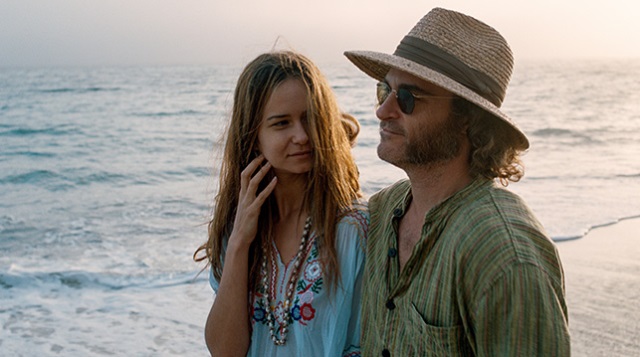
Inherent Vice is Paul Thomas Anderson’s seventh full length film, based on Thomas Pynchon’s seventh novel (published in 2009). But no Pynchon novel has ever been adapted for film; his early-career 1960’s and early 1970’s trifecta (V., The Crying of Lot 49, and Gravity’s Rainbow) are absolute classics of counterculture literature, but they and his later works were resistant to adaptation. PTA has pulled it off, creating a film parallel of Pynchon’s shambolic prose and outrageously-named side characters (though several of these have apparently been lost in the transition). The redoubtable Joaquin Phoenix plays “Doc” Sportello, a P.I. in a California beach town in 1970, who in time-honored film noir fashion is brought a confusing missing person case which twists bewilderingly through endless leads and complications until by the end it’s well-nigh impossible to tell if the bad guys were caught or if they weren’t the good guys all along. People who are complaining that they don’t understand the plot have clearly never watched noir; in the ur-noir The Big Sleep, with Bogie and Bacall, original writer Raymond Chandler famously told the screenwriters that he didn’t actually understand what was happening in the novel he himself had written. The best films noir similarly have a feeling of having gone off the rails as soon as the detective is on the case, with each followed lead pointing to yet another character with another murky motivation. (Also, in true noir, the lead must have the crap kicked out of him at least once and preferably over and over again.)


There have been other neo-modern, California-based, humorous, “sunny” films noir, and lots of critics bring them up as points of comparison, with Altman’s The Long Goodbye and the Coen brothers’ The Big Lebowski being the most obvious; these are fantastic movies in their own rights, but Inherent Vice is something very different. Long Goodbye’s primary hook is the 1940’s-detective-taken-out-of-his-time angle, Philip Marlowe going to sleep as Bogart and waking up in hippie-dippie L.A. and in Elliott Gould’s schlumpy body. Lebowski is the Coen’s reworking of the Bogart film’s beats into a 1990’s context, where Jeff Bridges’ reluctant Everydude is dragged through each noir step against his will. In Vice, Phoenix is a good detective; people around him are offbeat oddballs, but there’s nothing sloppy about the way he conducts his investigation. The missing person case is somehow connected to his great past love, played by Katherine Waterston; plenty of other friends and acquaintances are willing to assist him and despite the straight world’s distaste for his shaggy ways, he is able to gain access to the contacts and crime scenes he needs. The key to Vice is Phoenix’s relationship with his terminally grumpy frenemy counterpart in the straight world, Josh Brolin’s Lieutenant  Detective Christian F. Bjornsen, or "Bigfoot." Brolin is at odds with Phoenix and everything he stands for, and yet they can meet halfway in their collaboration to find answers — and, in fact, by the end Brolin has gone farther than Phoenix has in his attempt to understand the other’s viewpoint.  


Reminds me of:


Like Winterbottom’s Tristram Shandy (from the book by Sterne), Gilliam’s Fear and Loathing in Las Vegas (Thompson), or Kubrick’s Lolita (Nabokov), this was another one of those “unfilmable author/unfilmable novel” projects for which the filmmaker has been given enough support (and taken a sufficiently large step back from the source material) to create a workable film version. In each case, the adapters have had to come up with new filmic structures and elements which somehow capture unique aspects of the written work. I’m not attempting in this short essay to tease out all the ways that Anderson (brilliantly, in my opinion) accomplishes this, because I’m going to need to own the film and watch it a bunch more times for that. But the most obvious modification (and the one remarked upon by every reviewer — I’m not claiming any insight here) is the selection of Doc’s old friend Sortilège as the voiceover narrator and the casting of singer/songwriter Joanna Newsom to play her. She’s not supposed to be a reliable narrator at all, but she serves at least two irremovable functions: she acts as a welcoming, pleasing connection into Phoenix’s world, giving us some empathy and understanding for his character without having to directly introduce Doc’s own voice, and of course she allows Anderson to bring in a huge dollop of Pynchon’s writing. Voiceover narration in a film is almost always a bad idea — but in adaptations of work where the author has a very distinct voice, and where that voice acts as a character of its own in the narrative, narration can be the vital connection between the film and the page. (This doesn’t matter if the written work is plot-driven or if the characters themselves speak to each other in distinct voices. But imagine Clockwork Orange without the pages and pages of Burgess text that Kubrick allows Malcolm McDowell to read in voiceover.) Perhaps the similarity between all of these positive examples is that unreliable narrator — narration as a character, where we’re asked to evaluate its motivations and truthfulness just as we study actions onscreen and suss out what they say about internal states. Some books are clearly going to lend themselves to that treatment, and here Anderson’s smart idea to is not let Phoenix have a Doc Sportello V.O. — forcing us to interpret his actions and reactions — while allowing Newsom’s soothing voice to keep us engaged.


But then — the guilt!


I am a massive, colossal, irredeemable, unapologetic, unmitigated fanatic for PTA. He and the other Anderson are my favorite working guilty-pleasure filmmakers. Until they start blowing it — i.e., until never, per their track record so far — I am going to be in the cinema seat for the premiere week of their new movies, and I am not going to be sitting there in critical or questioning or snarky mode — I am going to be sitting there in a receptive state, waiting to see what they have brought to show me, expecting to be told something new, and if I’m not instantly gratified by some easy, crowd-pleasing fluff, I’m going to be working harder to understand what they say, not going away feeling like they failed. This is my unashamed statement of fact. Thank the heavens above that I am not a "critic" and that these aren’t “reviews.”


I’ve mentioned a number of films based on book above — Lolita, Tristram Shandy, Clockwork Orange and so on — but whereas I’ve actually read all those books, the truth is I’ve never read a word of Pynchon, not Inherent Vice nor any other. I’ve always intended to read them, especially The Crying of Lot 49, which is one of those sort of books that was so spiritually akin to all the books/music/films I did read/hear/watch that I find myself in that weird pop-culture position of being able to grok references to things like Silent Tristero’s Empire (W.A.S.T.E.) or the Yoyodyne Corporation despite never having actually read the source.


Pitch:


At the risk of seeming purely prurient, the lengthy single-take scene which moves from a key Phoenix/Watterson conversation into and through their . . . spirited lovemaking is an acting miracle. Maybe I’ll have a different feeling after I’ve seen the movie a few more times, but in the theater I was holding my breath.


*For movies and shows which are current — in theaters or streaming — I'm posting a short, less-spoilery take on #WhatThomWatched (and generally only when something really strikes me as worth passing on). These shorter essays are labeled Glance.