Showing posts with label HorrorFilm. Show all posts

02 May 2015

#WTW: The Pit and the Pendulum

(Boo! It's #WhatThomWatched #24....)

#WTW: The Pit and the Pendulum

The Pit and the Pendulum

(1961, Roger Corman; from The Vincent Price Collection, Shout! Factory disk set)


From Brian De Palma’s horror-movie homage to the real thing: The Pit and the Pendulum*, a prime entry in the Vincent Price/Roger Corman series of collaborations based on Edgar Allan Poe stories and themes. In addition to being the films that really put Price on the map, these are often cited as the best examples of how Corman’s low-budget, streamlined-process filmmaking could turn out gorgeous and even groundbreaking results: he knows where to put the money (scripts by Richard Matheson and other top talents, a couple of eye-popping setpieces) and where it can be saved (very limited sets and little-to-no location shooting, public domain stories, costumes and props recycled from other films). The only other key thing he needed was a troupe of actors who knew how to commit 100% no matter what the premise. Price can be accused of hammy overacting, but that’s what works for these scripts, and no one did it better.

#WTW: The Pit and the Pendulum

#WTW: The Pit and the Pendulum

As with the other Poe films by Corman, the script takes its title and one act (the final section) from the short story and fills out a full-length movie by inventing story elements that are Poe-esque. Here, John Kerr travels from England to the castle of his brother-in-law in 16th-century Spain to investigate the reported death of his sister (Barbara Steele) six months earlier. There he meets the tightly-wound Price, his sister’s widower; Price’s younger sister (Luana Anders); and the family physician (Antony Carbone). Kerr pushes and pries for details, eventually getting the story out of the Spaniards: rather than the “rare blood disease” cover story the household has been telling, Steele had been going crazy — becoming obsessed with the castle’s collection of Inquisition-era torture devices — and eventually locked herself in an iron maiden, literally (per her husband’s reluctant retelling and Carbone’s confirmation) dying of fright. Furthermore, as Anders reveals to Kerr (who doesn’t buy this whole story but sticks around to investigate), there’s a whole back-story to poor Price’s jumpiness; when he was a child living in the same castle, he happened to witness the death of his mother and her lover at the vengeful hands of his inquisitor father (also played by Price). Therefore the latter-day Price is a nervous wreck, terrified by his own house and the memories that live there. The screw is turned another notch when Kerr demands to see his sister’s remains; as he and Carbone disinter Steele’s corpse, Price protests that it was Steele’s worst fear to be sealed in a casket alive . . . . of course, in her absence, this fear has been transferred to her doting husband, and when her (his!) nightmare scenario is confirmed, it’s time for Price to go over the edge. (Which, needless to say, is what we as the audience have been waiting for.) 

#WTW: The Pit and the Pendulum

#WTW: The Pit and the Pendulum

Plenty of critics (many contemporary to the film; fewer but still some today) accuse Price of scenery-chewing here, but whatever you may say about Price and his acting style, it’s undeniable that he can convey internal states using his face and eyes and with his body and carriage. Here he gets to play a completely corrupted evil guy, a kind and even likable good guy, and finally that same good guy driven utterly insane, and you can tell that last just from his childlike expression of confusion:
#WTW: The Pit and the Pendulum

Note that all of this has very little connection to the source story. The original is tied to the Spanish Inquisition, but anachronistically takes place a couple hundred years after its heyday, while the film is more realistically set during it. Poe’s story is primarily a first-person account of torture, with a bizarre and inexplicable device (a room with a descending blade, a bottomless pit, and walls that can both push inward and become red-hot) and unseen torturers with unknowable motivations; it creates pure terror in the reader, nothing more or less. The film takes the Spanish setting and the idea of a descending, swinging razor blade (centered in a pit), but then has to build the rest of the story around it. Matheson chooses Gothic themes that are very common to Poe’s work: premature burial, grief over the death of a beloved woman, generations doomed to repeat tragedies, and inevitable descent into madness. There’s no supernatural theme in this one; the horrors of the torture implements in the mansion and the Inquisition in general seem to hang over everything, but there’s no literal ghost or spirit. All told, other than a very credulous reliance on nose-on-the-face Freudianism (apparently a common Corman trope), this plot is relatively “realistic” — for a Price horror role, anyway. (All eight Corman “Poe movies” similarly spin out loosely from their source material; some are better efforts than others, but they all use the talents of either Matheson or another Twilight Zone stalwart, Charles Beaumont, with only one exception — and that one (The Tomb of Ligeia) was written by Robert Towne!)

#WTW: The Pit and the Pendulum


Reminds me of:

Anthology television shows from the same decade like The Twilight Zone and The Outer Limits, many episodes of which also are set-bound and tend to use simple/recycled props and set dressing. This works particularly well for the small screen; it forces the viewer to pay attention to the story and acting, not to spectacle. As with Corman, Rod Serling and the other producers of these shows knew where to spend their money; Twilight Zone for example shot most of their episodes on film even as they worked around many standing sets and other less expensive locations, creating a high-quality look that stands up today despite the fact that there are few custom setpieces. And speaking of these shows, it’s easy to look at the mysteriously slashed portrait of Steele and think of Serling’s 1970’s horror anthology Night Gallery.
#WTW: The Pit and the Pendulum

The movie opens with an abstract scene of swirling oil colors, now somewhat of a 1960’s cliché given the heavy use of similar effects in later “groovy” visuals, often coupled with psychedelic music. But it’s easy to imagine that in 1961 this opening was an excellent lead-in for the weird, non-specific dream landscape of the film including Kerr arriving on a desolate and unpopulated landscape, staring out at the mansion perched on the edge of a cliff. (Non-objective color fields aren’t completely out of use, either — P. T. Anderson uses color fields by the artist Jeremy Blake to open and set off sections of Punch-Drunk Love, for example.)
#WTW: The Pit and the Pendulum

#WTW: The Pit and the Pendulum

#WTW: The Pit and the Pendulum

Speaking of color — of course this and the other Corman Poe movies have riotously rich color in many scenes (I’m looking forward to watching The Masque of the Red Death in particular on that score) . . . but here we also have the flashback sequence, which is shot black-and-white and then processed into a rich blue and/or red (and filtered, and distorted). This is nothing new as an emotional elevation technique but I’m reminded most recently of Youth of the Beast and the black-and-white-to-color games that Suzuki plays there.


But then — the guilt!

Horror film experts have so much experience with these films and can cite myriad ways that this and other Corman movies influenced later productions, especially Italian giallo films and British gothics from Hammer Films. I am so far behind that I’ll never catch up — horror is just not my main bag. That said, this is just the first Vincent Price movie I’m watching out of the two Shout! Factory box sets I’ve got (plus The Fly, plus Shout! has announced an upcoming third Price box), not to mention the rest of the Val Lewton box . . . this all amounts to a mere fraction of the genre but it’ll keep me busy for a while.

Pitch:

Stephen King has cited the first big shock scare in Pit as “the most important moment in the post-1960 horror film,” which is a darn-near impeccable recommendation for anyone interested in horror history. For me, it’s my first time to really watch actress Barbara Steele in action after years of reading reverent tributes to her in my “weird movie” books, and she’s as amazing as advertised. Her first moment of reversal — where her true nature is revealed — is chilling, and played far more naturalistically than Price (as good as he is here).


* The actual title of the film is unclear; all of the promotional materials for the film call it The Pit and the Pendulum, but the on-screen title card (which many reference sources, IMDb included, take as the correct name for a work)
leaves off the “The” — Pit and the Pendulum.


18 April 2015

#WTW: Phantom of the Paradise

(#WhatThomWatched spooky-scary #23)

#WTW: Phantom of the Paradise

Phantom of the Paradise

(1974, Brian De Palma; Shout! Factory disk)


By rights, Brian De Palma’s horror/comedy/musical should be at least as famous as The Rocky Horror Picture Show, which was gestating at the same time, but Phantom of the Paradise was plagued by horrible luck when it opened in 1974. As detailed in the 2006 French documentary Paradise Regained (included on the recent Scream Factory release), the film was hit with no fewer than four lawsuits in the days just after post-production wrapped, seriously hampering its release: Universal called the film an infringement on the Lon Chaney Phantom of the Opera from 1925; King Features sued as the owners of the comic book character “The Phantom”; the manager of a rock frontman who had been tragically electrocuted onstage in a manner uncomfortably close to a comic death in the film sued for defamation (not named in the docu, but most likely Peter Grant, manager of Stone the Crows guitarist Les Harvey, killed in 1972); and, most damaging to to De Palma’s intricately crafted production design, Led Zeppelin. Their record label had just been registered as “Swan Song Records,” and their manager (Peter Grant again) didn’t like the use of “Swan Song Enterprises” as the name of the fictional company in the movie, run by the evil impresario played by Paul Williams. The filmmakers were forced to use very obvious optical mattes to cover up names and logos throughout the movie, ruining many scenes; other shots had to be cut entirely. The title had to be changed (from the original’s simple Phantom) and all the artwork and promotional materials redesigned. And then the premiere was an unexpected disaster — the audience just didn’t get it. (Except, oddly, in Winnipeg, which is still the center for Phantom phandom worldwide.)*
#WTW: Phantom of the Paradise

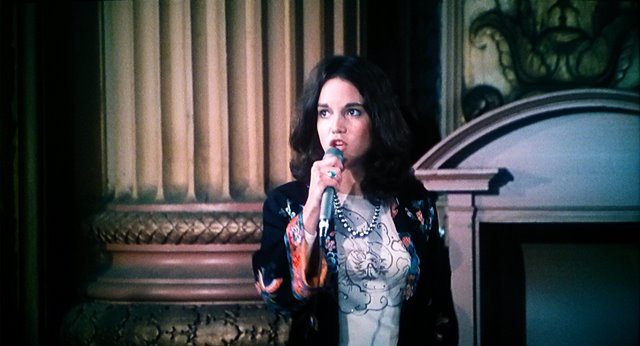
Phantom’s ambitious story combines several classic psychological horror plots: in addition to the Gaston Leroux serial from 1909-1910 in which a deformed and frustrated artist haunts the venue where he was ruined, lusting after the pure woman who is his last connection to humanity, the movie also loops in the Faust story and Oscar Wilde’s “The Picture of Dorian Gray.” Williams makes for a singularly seductive Mephistopheles, from his purring voice to his affected dress; he’s smartly cast to set his diminutive size and seeming harmlessness against his all-powerful, all-seeing evil; his henchman played by George Memmoli is huge in contrast to Williams. William Finley as (first) the hapless and goofy songwriter taken advantage of by Williams, and (later) as the mangled and tortured monster again bested by Williams, is beautiful to watch, with so much of his performance in his carriage and the one visible eye through his mask; in one nicely underplayed gag, all of the door frames in both Williams’s mansion and studio are 5” 6’ to accommodate him, forcing Finley to grotesquely contort his body to get through them. The ingenue and Finley’s obsession is played by Jessica Harper, who projects wholesomeness and likability even as she proves to be just as ambitious as both Finley and Williams. Finally, four key musical frontmen play the contract employees of Williams’s conglomerate who are tasked with delivering his music to the masses, packaged and repackaged to fit the latest trend: Archie Hahn, Jeffery Comanor, and Peter Elbling front doo-wop band The Juicy Fruits, surfer band The Beach Bums, and shock-rockers The Undeads in turn, with Gerrit Graham added to the final band as the lead singer intended to carry the Faust role written by Finley (and which he’d intended for Harper). The changing bands, cynically sold as the next hot thing, are a powerful conceit, explicitly accusing mass media and mass entertainment in the grinding down of art and artists, while implicitly criticizing the (teenage?) audience that drives the evil empire with their undiscerning consumption. (There’s some suspicion in the documentary material on this disk that this theme wasn’t understood by the distribution people at Fox, who tried to sell the movie to the same teens that were being satirized, with mixed results.)


#WTW: Phantom of the Paradise

#WTW: Phantom of the Paradise

#WTW: Phantom of the Paradise


The De Palma hallmarks are all there — fully developed, in a surprisingly early entry in his oeuvre. It has his Hitchcock homage, an attack in a shower a la Psycho. It has his split-screen, here serving a truly tense scene: two angles on the same band rehearsal allow unsuspecting dancers and musicians to run into a time bomb that’s been planted in a rolling prop car, with the cameras following each as the car comes closer and closer together and eventually (after several minutes, during which the bomb’s ticking is heard throughout) reaches them just at the moment of mayhem. Another De Palma specialty is shown off in the long final scene, the Williams-Harper wedding sequence. Using the experience he’d gained with documentary-style continuous shooting for Dionysus in ’69, De Palma put all of the cameramen in costume as members of William’s ubiquitous press photographers. De Palma’s choreographers-cum-crowd-wranglers were tasked with organizing the scene’s overall action: the primary actors had lines, blocking, and marks to hit; other actors had specific bits of business they had to fit in; the remaining extras mostly had to stay out of the way. Then the entire sequence was filmed in one go, with everything taking place in real time pretty much as it does in the final film. De Palma had to trust that he would have enough varied footage to cut together to tell his story; the end result (reportedly from only two takes) feels “real” in a sort of hyped-up, media-exaggerated way — furthering the overall theme of corporations manufacturing and selling packaged, inartistic experiences.

#WTW: Phantom of the Paradise

#WTW: Phantom of the Paradise

#WTW: Phantom of the Paradise

Reminds me of:

Rocky Horror, obviously . . . . I love The Rocky Horror Picture Show as much as the next seventies kids, but Phantom has far more going on than Richard O’Brien’s goof on RKO B-pictures ever did. Rocky gets its shocks (and, frankly, most of its value) from transgression and its twisted one-to-one cooption of each beat from square, classic horror movies; that’s made clear from its first scene (listing the science fiction and horror films it will cite) to last (where the RKO logo is literally the portal back to the alien world). There’s no real social satire in Rocky beyond its minimal critique of the “straight world” suburbia of Denton contrasted with the freaks and the freak nature that apparently exists in everyone. The joys of Rocky really surface when the movie is beside-the-point, just a canvas for a communal experience where theatergoers yell and dance and throw things at the screen. Phantom, in contrast, actually rewards close watching; like all De Palma films, it’s a beautiful object which opens up to reveal hidden themes and ideas.
#WTW: Phantom of the Paradise


Of course both Rocky and Phantom have great music. Williams’s songs and score are just perfect; it’s a bonus that several of the numbers are intended to mimic and poke fun at certain popular rock styles to be sung by the three iterations of Swan Enterprises' house musicians reconstituted as 1950’s greasers, 1960’s surf dudes, and 1970’s shock rockers (like Alice Cooper). Every time Williams composed for the the screen, he turned out exceptional work: The Muppet Movie, the “intentionally bad” songs for the songwriters in Ishtar, Bugsy Malone (which has subsequently been turned into a stage musical), A Star is Born. I wish he’d been given as many chances over the years to score films as the (admittedly also awesome) Randy Newman. (Interestingly, given this movie’s plot point of a composer creating “the first rock version of 
‘Faust,’” Newman wrote his own (not very successful) Faust in the mid-1990’s; I have the concept album.)

#WTW: Phantom of the Paradise


The sequence of the bomb being placed in a prop car trunk is a clear echo of Welles’s famous opening shot for Touch of Evil, where the camera follows a bomb-laden car through a border crossing in continuous real-time; the double-framing is almost a one-upmanship in terms of technical prowess. It’s not as beautiful as some of his other split-screen work (I’m very partial to images in Blow Out) but it is chillingly functional. I’m sure De Palma put in a zillion more directorial homages beyond Hitchcock and Welles; I’m too dense to find them, but I’ll say (betraying my personal obsessions again) that the ever-present cameras and Williams’s console of spying video screens reminds me of Dr. Mabuse in general and specifically of my favorite, Lang’s The 1,000 Eyes of Dr. Mabuse.
#WTW: Phantom of the Paradise

#WTW: Phantom of the Paradise

#WTW: Phantom of the Paradise

But then — the guilt!

This movie has plenty of recognizable character actors and repeat De Palma performers, but I was particularly bothered by Archie Hahn, one of the three contract musicians and the lead singer of the first number, the Juicy Fruits’ “Goodbye, Eddie, Goodbye” — he felt so familiar to me, like an old friend you recognize at a party and just can’t place. I looked at his long credits list in IMDb for a while before it came to me: He has that literally-five-seconds-long role in This is Spinal Tap as the hotel employee delivering room service to the band, with the absolutely perfect line delivery: “Thank God! Civilization!!”
#WTW: Phantom of the Paradise

Watching Paul Williams’s performance and listening to his songs, and then seeing him on this disk’s extras (in particular a long interview conducted by his friend, director Guillermo Del Toro) reminded me yet again of the apparently superlative 2011 documentary about Williams’s career and fight with drug addiction, Paul Williams Still Alive. It’s on my neverending list of films to see, and now it bumps up a notch or two.
#WTW: Phantom of the Paradise

Actor William Finley thinks that the Phantom costume he helped design — full-head mask, black leather body, cape — was ripped off for Darth Vader in Star Wars VI: A New Hope, specifically the blue-and-red light-up pushbuttons on the chest. This is in the BTTG section and not the RMO section because, full admission: I would never have noticed this.
#WTW: Phantom of the Paradise

Pitch:

I think that you are either grabbed by the very first moments — the Juicy Fruits singing their 1950’s pastiche — or you aren’t. All of the show’s humor and appeal is right there. Or if you’re more of an old-school horror aficionado, the sequence where Finley is transformed into the monster is perfect — genuinely disturbing yet still funny and a clear connection to the horror films of the past.


#WTW: Phantom of the Paradise


* Pencils down for me: Now that I’m done writing this #WTW (and you, theoretically, are done reading it), it’s time to really dig deep into Phantom of the Paradise by exploring every corner of The Swan Archives. This tribute site is one of the best I’ve ever seen on the web — beautifully written and designed — and while it helped me avoid some obvious mistakes here, I promised myself that I wouldn’t indulge in their scene-by-scene visual analysis, their extensive production and release history, or their long list of artifacts and collectibles until after I’d posted my own hastily considered points, lest I outright steal their work. They carried the torch for Phantom for such a long time — becoming the official owners of the film’s outtakes and other cut scenes — that when it came time for Arrow Films and Shout! Factory to create these definitive editions in 2014, it was this site (the “Principal Archivist”) who provided all these extras to the two companies. It’s a master class in how fandom should work. Please go there now!


06 March 2015

#WTW: Donnie Darko

(#WhatThomWatched Chapter Seventeen a.k.a. The Tangent Vortex...?)


Donnie Darko

(2001, Richard Kelly; 20th Century Fox disc)


Donnie Darko boasts strong visuals; excellent early performances from Gyllenhaal siblings Jake and Maggie plus Jena Malone, Daveigh Chase, Ashley Tisdale, Seth Rogen and more; and an intricate puzzle-plot that is sublimely creepy and (at least the first time around) freighted with significance. It’s purposely (and effectively) set in the near-past, in a late-1980’s that allows it to comment mildly on the Bush/Dukakis presidential contest while also evoking a viewer’s own younger days, largely through the soundtrack (which includes songs by Tears for Fears, Joy Division, and Echo and the Bunnymen). But it’s also a product of a near-past era of filmmaking, another beneficiary of the post-1990s indie boom that produced such low-budget and imaginative first films as Shane Carruth’s Primer or Christopher Nolan’s Following (and subsequent Memento). Director Richard Kelly’s longer 2004 recut notwithstanding, this is a film that benefits from its rough edges, leaps of logic and general shagginess.

Jake Gyllenhaal plays a high school student in suburban Virginia with an unusual problem: he hallucinates a man in a fur-and-metal rabbit costume who demands that he leave his home at night in a sleepwalking trance and break water mains, commit arson, and worse. But this is offset by several points that seem to be deliberately opposing the tropes of similar stories: he’s got a loving family, plenty of friends, a couple of caring teachers, and a genuinely concerned psychiatrist in whom he can confide; he’s caught the eye of the new girl in class and has no problem getting to know her; and most unexpectedly, he sees his terrifying rabbit when he takes his meds, not when he goes off them. Yes, some of the school personnel are awful, and there’s a pair of bullies who menace him, but the villains (particularly a self-help guru played by Patrick Swayze) are all as cartoonishly flat as if they’d been inked into the film by hand. This dearth of stereotypical problems forces the viewer to really focus on Gyllenhaal’s internal state: he’s being told that the world will end unless he intervenes, and he seems to be following a trail of clues that points to time travel as the final answer.


The actors are committed — the new faces, old hands, and ringers alike (for the honor of using their names, stars like Swayze, Noah Wyle, and Katharine Ross (!) are rewarded with two or three Big Scenes apiece; Drew Barrymore also earns an executive producer credit by having believed enough in the early script to get the movie made). Mary McDonnell as Donnie's mother gives a performance that neatly externalizes the pain and difficulty of raising teenagers, and Holmes Osborne is convincing as a loving and defensive father. Sean Smith and Ronald Fisher as Gyllenhaal’s best friends are bewildered by his sudden odd behavior, and Malone is intrigued and intriguing in turn as his love interest. As for Gyllenhaal, he’s in almost every scene.


Reminds me of:

It’s a lot for one character to carry. Donnie is, annoyingly, that exceptional kid who is too smart for his teachers, who stands up to the bullies and wins the arguments, who confounds adults with his depth, and in the end is the unthanked savior of the universe — all with little to no evident irony. He’s like Catcher in the Rye’s Holden Caulfield if Holden were 100% right and everyone else was a “goddam” phony. A key scene has Donnie confront his hallucination with the question “Why do you wear that stupid bunny suit?” To which the rabbit — his name is Frank — replies “Why are you wearing that stupid man suit?” It sounds profound, or at least meaningful, on first viewing, but diminishes the more you think about it. As an example of what troubled teen Donnie might think is profound, it’s gangbusters, but the movie seems to expect us to honestly be wowed.


There are strong echoes of other films. For example, towards the end students in Halloween costumes strike out on bikes for an urgent ride through town; it’s so reminiscent of E.T.: The Extraterrestrial that it can’t be an accident. Scenes of Samantha Darko’s dance troupe Sparkle Motion — serious and earnest, unaware that they are oversexualized for 4th graders — make a similar satirical point as Happy, Texas or the later Little Miss Sunshine, though there’s not much development of the idea here. Closeups of the elderly Roberta Sparrow (suffering from dementia, her neighbors think, but she might be a time traveller!) as her younger self in a group photo are zoomed into like the final photo closeup of Jack Nicholson in The Shining.


Some of these may not be conscious homages to films or genres, but these examples hint at a flaw with Donnie Darko: It wants to be too much —a horror movie, a science-fiction puzzle, a coming-of-age story, but also social commentary, a gloss on the 1980’s, and even a comedy — and it never finds a tone which supports all of these elements at once. For some, myself included, the story works fine (even given the tone shifts) without a full explanation of how the science-fantasy mechanics operate. But Kelly did not create his movie in this form; infamously, he was forced to cut 20-30 minutes from his original festival version. When Donnie was a massive seller on DVD, purchased and watched by a far larger audience than it had in its theatrical run (opening a film about a plane that falls out of the sky a few weeks after 9/11 didn’t help), Kelly was invited to cut a completely new version for another theatrical release in 2004. That version added chapter delineations with interstitial imagery and explanatory text purportedly taken from the book The Philosophy of Time Travel (an imaginary textbook written by the Sparrow character); these snippets make many of the events in the film logical — “logical” in that they support a giant backstory in which beings from the future can implant suggestions in someone’s mind to guide events, and in which a tangled set of physical rules governs the fabric of the universe. The additions, taken at face value, explain the plot; but without the mystery of inexplicable events, the movie can only be as good as its mythos — which does not rise far above that which high-school Donnie might cook up with his buddies between conversations about Smurfs. In the original version, the lack of explanation for the same vaguely fanfic-y rules creates a true tension — how much of what transpires is only happening in Donnie’s mind, whether fueled by madness, drugs, placebos, or reality?


This is arguable, superficial and a little mean, but in my opinion Donnie Darko shares a trait with Forman’s Amadeus: in each case, its director released an extended version which doesn’t play as well as the original. (But there are many, many fans of the director’s cut of Donnie. If you’re one, educate us in the comments for this post, won’t you?)


But then — the guilt!

I loved this film so much when I first watched it; it’s rare for something to fall so far for me on a second viewing. That’s not how rewatching usually works. I remember being very excited for Kelly’s second big feature as writer-director, Southland Tales in 2006. But as the movie’s release approached, the early critical response soured quickly. I never did wind up seeing it and it tanked equally with critics and audiences; his 2009 The Box never even appeared on my radar (though it was slightly better received). I feel bad about it all; maybe I’ll give one of them a spin someday, but I’m booked through 2018 at this point. He’s got a new one in the works too. Maybe I can start fresh. (Defenders of Southland Tales, feel free to join the Donnie director’s cut fans in the comments.)


Pitch:

Donnie’s utterly creepy mirror-stare both at himself and, later, at Frank . . . . Between this and Svankmajer’s Alice, it’s a wonder that anyone can keep a pet rabbit in the house and still sleep at night.