Showing posts with label ComedyFilm. Show all posts

16 May 2015

#WTW: Seven Chances

(Another mild milestone! here's the 25th #WhatThomWatched) (plus another 7 Glances...)
#WTW: Seven Chances

Seven Chances

(1925, Buster Keaton; from The Art of Buster Keaton box set, Kino)


Lots of people like their romantic comedy sappy; some prefer it a little weepy. And then there are the enlightened few who want it deadpan. And no one does deadpan better than the Great Stone Face, actor-director Buster Keaton. He is now celebrated for his annus mirabilis times ten, the decade from 1920 to 1929, during which he completed 13 features and 19 shorts under his famously tight control, and these films all together contain numerous highlights and historic scenes, gags, and shots. But only one scenario has been endlessly remade and rehashed into (inferior) comedies to this day (sometimes credited, but usually just stolen): the peerless Seven Chances. Starting with a David Belasco-produced play from 1916, Keaton came up with riffs on a basic comic idea that could only be realized in film, winding up to one of the most famous sight gags ever created.

#WTW: Seven Chances

The plot is pretty ridiculous, but Keaton’s light touch keeps it just on the right side of plausible. His character has a perfect girlfriend (Ruth Dwyer), on whom he dotes but to whom he repeatedly fails to commit. On the morning of his 27th birthday, as he and his business partner are agonizing in their office over a ruinously expensive legal issue, he’s pursued by a man who he thinks is a process server but who turns out to be the executor of his grandfather’s estate: Keaton’s business troubles are over, because he’s inheriting a fortune, seven million dollars. As long as he’s married. By 7:00 PM — on his 27th birthday, of course.
#WTW: Seven Chances

#WTW: Seven Chances

#WTW: Seven Chances

#WTW: Seven Chances

#WTW: Seven Chances

#WTW: Seven Chances

#WTW: Seven Chances


No problem — he’s got Dwyer on his line, just waiting for him to reel her in! But in a scene that is far better than the usual rom-com “misunderstanding that puts the couple at odds,” she’s turned off by his newfound urgency — or in his words, he’ll inherit the money “provided I marry some girl today” . . . oops. Despondent at the loss of his true love, he trudges back to his partner and his attorney, who then have one mission for the rest of the film: get Keaton hitched at any cost. The romance is built in to the fact that we know Keaton and Dwyer are still in love; we don’t have to see any further interaction between them. Keaton’s emotionless demeanor tells us here exactly how unenthusiastic he is at each opportunity, starting with the first set of women — all seven women that he knows at his country club and therefore can approach without a formal introduction, the “seven chances” of the title — and then continuing down an increasingly desperate search. As he runs out of the socially acceptable choices, the options (and the jokes) turn surprisingly transgressive, starting with the gorgeous woman who accosts him in the county club, asking “Would anyone marry me?” with doe-eyed innocence; as Keaton proudly walks her past all the women who rejected him, the girl’s mother shows up to scold her — she’s an underage teen who has dressed up and snuck into the club as an adult. From this narrowly avoided scandal, his choices quickly devolve as random woman after woman is approached and proves to be unsuitable; as a title card explains at the end of this sequence, Keaton approaches and is rejected by “Everything in skirts including a Scotsman.”
#WTW: Seven Chances

#WTW: Seven Chances

#WTW: Seven Chances

#WTW: Seven Chances


Meanwhile, his partner has secured a church and minister and told Keaton to be there by 5:00, promising to have a backup bride in place in case Keaton strikes out; his bright idea for this is a newspaper ad:

#WTW: Seven Chances

Of course, this leads to the last third of the movie, in which hundreds of women show up; told by the minister that they are all victims of a practical joke, they are out for Keaton’s blood and pursue him through an escalating series of gags, all based on the idea of a mob of angry women cutting a path of destruction through traditionally male groups (drivers on the streets, workers at a job site, a football game) and male authority figures (streetcar operators, a marching police squad). On the one hand, this all reads as an old sexist joke about what unmarried women are like; in contrast to the beautiful country-club women who reject him in the second act, these third-act pursuing brides tend toward the older, less-attractive “battleaxe” stereotype (abetted by the fact that many of them are certainly played by male extras in drag). But, at the same time, the women are shown to be an unstoppable force, literally tossing man after man out of the way; en masse, women have the power and will to upend society itself, working together across generations and even races (more on that below). Along with Dwyer and Dwyer’s mother, who quickly realize that Keaton is just being a ninny and work to patch things up (money or no money), women in this story repeatedly come out ahead. 

#WTW: Seven Chances


#WTW: Seven Chances

#WTW: Seven Chances

#WTW: Seven Chances


In addition to Keaton’s expected mechanical stunts there are several surprising and wonderful directorial choices here; later in the film there will be moving vehicles galore, but early on a couple of car trips are handled by Keaton climbing into a parked car, sitting immobile while the surroundings dissolve to the destination, and climbing out. Not only does this economize and focus the storytelling, it hints to the audience that they’ll have to wait for the inevitable vehicular mayhem to come. There’s great use of a moving camera that follows Keaton in his quest, eventually representing the increasingly large mob that’s stalking him. The script also has impressively mature touches, probably from the original source play; as Keaton checks his pockets in the church to make sure he’s got everything, he pulls out a bouquet, the ring, a marriage license, honeymoon tickets to Niagara Falls — and then tickets to Reno, which he puts away in an inside pocket; Reno was the divorce capital of the country at the time, with the shortest residency requirements. There’s no question that Keaton’s character has no illusions about marrying for love.

#WTW: Seven Chances

#WTW: Seven Chances


Reminds me of:

All of those smart, liberated women at the country club have flapper-style bob haircuts, and some of them seem to be specifically channeling Louise Brooks in Pandora’s Box — but a quick check shows that this can’t be the case; Brooks had not yet broken out in 1925. Yet multiple women including the receptionist (“Miss Smith”) and some of the “chances” have the jet-black flapper bob. The ubiquity of short hair is more likely due to Colleen Moore (Flaming Youth was released in 1923) or Olive Thomas (The Flapper and others from the early 1920’s); Clara Bow is also famous for the bob and had appeared on-screen many times by 1925, but her short hair was curly (and Irene Castle, who literally invented the “Castle bob,” also had curly hair). The heroine, Dwyer, has a curly bob too. (Speaking of fashion, I may as well note here the book that Miss Smith is reading; it’s Elinor Glyn’s Three Weeks, the trashy (and hugely popular) sex novel of the day, which had been made into a movie just the year before.)

#WTW: Seven Chances

#WTW: Seven Chances


So, spoiler alert if you somehow didn’t know — the genius finale that Keaton came up with (and the thing that finally scares off the pursuing mob) is an avalanche of increasingly larger rocks that his character inadvertently sets off. The sequence is hysterical and still amazing to watch; even knowing that those are prop rocks, not really as heavy as they look, their scale to Keaton is startling. I don’t know for sure but I can’t imagine that Spielberg and Lucas weren’t paying homage when they came up with the rock bit for the opening sequence of Indiana Jones and the Raiders of the Lost Ark. And yeah, Spielberg’s (single) rock is bigger, but Keaton’s free-fall down a slope with hundreds of rocks is still a more impressive accomplishment overall.
#WTW: Seven Chances

#WTW: Seven Chances

#WTW: Seven Chances


The mass of brides running, running, inexorably running in pursuit — sometimes suddenly joined by another mass from the side, unexpectedly — is certainly reminiscent of a horror-movie situation. Back when zombies were slow, up to and including the George Romero era, this wouldn’t have been as visually obvious. But now that “fast zombies” have arrived, the brides could easily compete as nightmare fuel.
#WTW: Seven Chances


My favorite Charlie Chaplin gag of all time is also a “stone face” bit — in one of his pre-Tramp shorts (The Idle Class), he’s a callous rich man; receiving shocking news in a note, he turns his back to the camera and begins to rack with sobs . . . until he turns and reveals that he’s really just been shaking a cocktail, with no expression on his face at all. I love deadpan.
#WTW: Seven Chances


But then — the guilt!

Keaton’s great movies of the 1920s have racist jokes about African-Americans and others, including (as with Dwyer’s servant, here, who is tasked with delivering an important note) actors in blackface. There’s no excusing this now and the blackface isn’t funny, no matter what the intentions were back then. If you are willing to look closely, there’s at least some evidence that Keaton was more progressive than some of his peers (albeit not progressive enough to stay completely away from blackface). There are at least three other roles for African-Americans in the film, one in each section: a well-dressed man at the club who opens a door and steps in front of Keaton just as he’s looking in a mirror; a woman he approaches on the street thinking to propose to her; and one of the many women in the church who accost him when they think they’ve been tricked (in her case she works with a white woman to pummel Keaton); all three of these appear to be played by black actors and not whites in blackface. In a movie from a later time, we wouldn’t think twice about a handful of what are essentially black extras (other than to perhaps note how few there are). But if you compare these four black characters, the only one who is cruelly satirized with the nasty stereotypes is the blackface actor; it’s almost as if the movie is saying that for the joke to be funny, a white guy has to be the buffoon, but when we’re meant to see a black person as real, a black actor will play him. That’s especially the case in the country club scene: It’s odd to see a black person there at all, unless he were to be costumed as wait staff; instead, everyone in the club including the waiters are white, and this gentleman is dressed exactly like Keaton — I’m not sure how that looked in 1925, but watching it today the thought is that this is just another member of the local high society. All this aside — regardless of Keaton’s intentions at the time — it’s still the case that these jokes don’t work today; thinking you’ve “turned black” in a mirror is not a cause for panic, and nor is the idea of wooing or marrying a black woman. There’s a similarly gentle-but-not-funny joke with Keaton approaching a woman who turns out to be Jewish (revealed when her newspaper is in Hebrew).
#WTW: Seven Chances (NOTE: NOT acceptable!!)

#WTW: Seven Chances

#WTW: Seven Chances

#WTW: Seven Chances


The music for this 2001 Kino release is by the great Robert Israel, ubiquitous across countless DVD and Blu-Ray releases of classic silents. I like Robert Israel’s music, of course. But . . . as I watched Seven Chances, I started to imagine it with a much more serious, sinister soundtrack, especially during the escalating chase sequence. Keaton’s social failures could take on a far more cynical and sour tone, and the gathering storm of brides could be scored as a horror show; I think the visuals in each case would work perfectly well. In fact the church scene has a lot in common with The Birds: Keaton’s character, unsuspecting, is asleep in the first pew when a single woman drifts into the church and sits at the very back. Then three more women float in; they glare at each other. Then we see a streetcar disgorge twelve women who all arrive in a group. Then from a shot outside the church we see streams of women begin to descend upon the church from every direction . . . .

#WTW: Seven Chances

#WTW: Seven Chances

#WTW: Seven Chances

I should make my whole family and everyone I know watch this every year, yet I never have. I was laughing so hard just while trying to take the screencaps that I was crying.

#WTW: Seven Chances

Pitch:

There’s a scene with Keaton in a car, trying to propose to a woman in the next lane over, that simply had to inspire my all-time-favorite Chuck Jones Roadrunner gag. Its timing is perfection. If you don’t laugh so hard that you are crying, your soul is clearly dead — or maybe you’re just in training to be the next Great Stone Face yourself.


<< The Pit and the Pendulum (-) Coming soon: Whiplash >>

18 April 2015

#WTW: Phantom of the Paradise

(#WhatThomWatched spooky-scary #23)

#WTW: Phantom of the Paradise

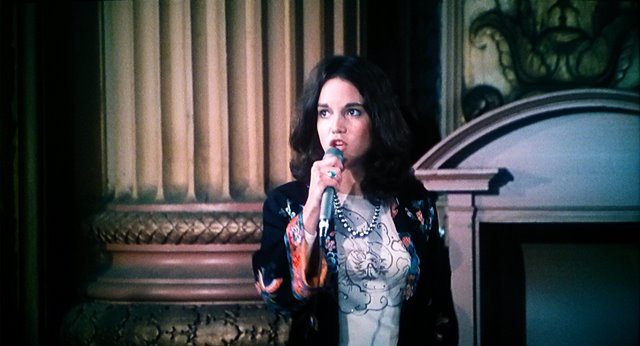
Phantom of the Paradise

(1974, Brian De Palma; Shout! Factory disk)


By rights, Brian De Palma’s horror/comedy/musical should be at least as famous as The Rocky Horror Picture Show, which was gestating at the same time, but Phantom of the Paradise was plagued by horrible luck when it opened in 1974. As detailed in the 2006 French documentary Paradise Regained (included on the recent Scream Factory release), the film was hit with no fewer than four lawsuits in the days just after post-production wrapped, seriously hampering its release: Universal called the film an infringement on the Lon Chaney Phantom of the Opera from 1925; King Features sued as the owners of the comic book character “The Phantom”; the manager of a rock frontman who had been tragically electrocuted onstage in a manner uncomfortably close to a comic death in the film sued for defamation (not named in the docu, but most likely Peter Grant, manager of Stone the Crows guitarist Les Harvey, killed in 1972); and, most damaging to to De Palma’s intricately crafted production design, Led Zeppelin. Their record label had just been registered as “Swan Song Records,” and their manager (Peter Grant again) didn’t like the use of “Swan Song Enterprises” as the name of the fictional company in the movie, run by the evil impresario played by Paul Williams. The filmmakers were forced to use very obvious optical mattes to cover up names and logos throughout the movie, ruining many scenes; other shots had to be cut entirely. The title had to be changed (from the original’s simple Phantom) and all the artwork and promotional materials redesigned. And then the premiere was an unexpected disaster — the audience just didn’t get it. (Except, oddly, in Winnipeg, which is still the center for Phantom phandom worldwide.)*
#WTW: Phantom of the Paradise

Phantom’s ambitious story combines several classic psychological horror plots: in addition to the Gaston Leroux serial from 1909-1910 in which a deformed and frustrated artist haunts the venue where he was ruined, lusting after the pure woman who is his last connection to humanity, the movie also loops in the Faust story and Oscar Wilde’s “The Picture of Dorian Gray.” Williams makes for a singularly seductive Mephistopheles, from his purring voice to his affected dress; he’s smartly cast to set his diminutive size and seeming harmlessness against his all-powerful, all-seeing evil; his henchman played by George Memmoli is huge in contrast to Williams. William Finley as (first) the hapless and goofy songwriter taken advantage of by Williams, and (later) as the mangled and tortured monster again bested by Williams, is beautiful to watch, with so much of his performance in his carriage and the one visible eye through his mask; in one nicely underplayed gag, all of the door frames in both Williams’s mansion and studio are 5” 6’ to accommodate him, forcing Finley to grotesquely contort his body to get through them. The ingenue and Finley’s obsession is played by Jessica Harper, who projects wholesomeness and likability even as she proves to be just as ambitious as both Finley and Williams. Finally, four key musical frontmen play the contract employees of Williams’s conglomerate who are tasked with delivering his music to the masses, packaged and repackaged to fit the latest trend: Archie Hahn, Jeffery Comanor, and Peter Elbling front doo-wop band The Juicy Fruits, surfer band The Beach Bums, and shock-rockers The Undeads in turn, with Gerrit Graham added to the final band as the lead singer intended to carry the Faust role written by Finley (and which he’d intended for Harper). The changing bands, cynically sold as the next hot thing, are a powerful conceit, explicitly accusing mass media and mass entertainment in the grinding down of art and artists, while implicitly criticizing the (teenage?) audience that drives the evil empire with their undiscerning consumption. (There’s some suspicion in the documentary material on this disk that this theme wasn’t understood by the distribution people at Fox, who tried to sell the movie to the same teens that were being satirized, with mixed results.)


#WTW: Phantom of the Paradise

#WTW: Phantom of the Paradise

#WTW: Phantom of the Paradise


The De Palma hallmarks are all there — fully developed, in a surprisingly early entry in his oeuvre. It has his Hitchcock homage, an attack in a shower a la Psycho. It has his split-screen, here serving a truly tense scene: two angles on the same band rehearsal allow unsuspecting dancers and musicians to run into a time bomb that’s been planted in a rolling prop car, with the cameras following each as the car comes closer and closer together and eventually (after several minutes, during which the bomb’s ticking is heard throughout) reaches them just at the moment of mayhem. Another De Palma specialty is shown off in the long final scene, the Williams-Harper wedding sequence. Using the experience he’d gained with documentary-style continuous shooting for Dionysus in 69, De Palma put all of the cameramen in costume as members of William’s ubiquitous press photographers. De Palma’s choreographers-cum-crowd-wranglers were tasked with organizing the scene’s overall action: the primary actors had lines, blocking, and marks to hit; other actors had specific bits of business they had to fit in; the remaining extras mostly had to stay out of the way. Then the entire sequence was filmed in one go, with everything taking place in real time pretty much as it does in the final film. De Palma had to trust that he would have enough varied footage to cut together to tell his story; the end result (reportedly from only two takes) feels “real” in a sort of hyped-up, media-exaggerated way — furthering the overall theme of corporations manufacturing and selling packaged, inartistic experiences.

#WTW: Phantom of the Paradise

#WTW: Phantom of the Paradise

#WTW: Phantom of the Paradise

Reminds me of:

Rocky Horror, obviously . . . . I love The Rocky Horror Picture Show as much as the next seventies kids, but Phantom has far more going on than Richard O’Brien’s goof on RKO B-pictures ever did. Rocky gets its shocks (and, frankly, most of its value) from transgression and its twisted one-to-one cooption of each beat from square, classic horror movies; that’s made clear from its first scene (listing the science fiction and horror films it will cite) to last (where the RKO logo is literally the portal back to the alien world). There’s no real social satire in Rocky beyond its minimal critique of the “straight world” suburbia of Denton contrasted with the freaks and the freak nature that apparently exists in everyone. The joys of Rocky really surface when the movie is beside-the-point, just a canvas for a communal experience where theatergoers yell and dance and throw things at the screen. Phantom, in contrast, actually rewards close watching; like all De Palma films, it’s a beautiful object which opens up to reveal hidden themes and ideas.
#WTW: Phantom of the Paradise


Of course both Rocky and Phantom have great music. Williams’s songs and score are just perfect; it’s a bonus that several of the numbers are intended to mimic and poke fun at certain popular rock styles to be sung by the three iterations of Swan Enterprises' house musicians reconstituted as 1950’s greasers, 1960’s surf dudes, and 1970’s shock rockers (like Alice Cooper). Every time Williams composed for the the screen, he turned out exceptional work: The Muppet Movie, the “intentionally bad” songs for the songwriters in Ishtar, Bugsy Malone (which has subsequently been turned into a stage musical), A Star is Born. I wish he’d been given as many chances over the years to score films as the (admittedly also awesome) Randy Newman. (Interestingly, given this movie’s plot point of a composer creating “the first rock version of 
Faust,” Newman wrote his own (not very successful) Faust in the mid-1990’s; I have the concept album.)

#WTW: Phantom of the Paradise


The sequence of the bomb being placed in a prop car trunk is a clear echo of Welles’s famous opening shot for Touch of Evil, where the camera follows a bomb-laden car through a border crossing in continuous real-time; the double-framing is almost a one-upmanship in terms of technical prowess. It’s not as beautiful as some of his other split-screen work (I’m very partial to images in Blow Out) but it is chillingly functional. I’m sure De Palma put in a zillion more directorial homages beyond Hitchcock and Welles; I’m too dense to find them, but I’ll say (betraying my personal obsessions again) that the ever-present cameras and Williams’s console of spying video screens reminds me of Dr. Mabuse in general and specifically of my favorite, Lang’s The 1,000 Eyes of Dr. Mabuse.
#WTW: Phantom of the Paradise

#WTW: Phantom of the Paradise

#WTW: Phantom of the Paradise

But then — the guilt!

This movie has plenty of recognizable character actors and repeat De Palma performers, but I was particularly bothered by Archie Hahn, one of the three contract musicians and the lead singer of the first number, the Juicy Fruits’ “Goodbye, Eddie, Goodbye” — he felt so familiar to me, like an old friend you recognize at a party and just can’t place. I looked at his long credits list in IMDb for a while before it came to me: He has that literally-five-seconds-long role in This is Spinal Tap as the hotel employee delivering room service to the band, with the absolutely perfect line delivery: “Thank God! Civilization!!”
#WTW: Phantom of the Paradise

Watching Paul Williams’s performance and listening to his songs, and then seeing him on this disk’s extras (in particular a long interview conducted by his friend, director Guillermo Del Toro) reminded me yet again of the apparently superlative 2011 documentary about Williams’s career and fight with drug addiction, Paul Williams Still Alive. It’s on my neverending list of films to see, and now it bumps up a notch or two.
#WTW: Phantom of the Paradise

Actor William Finley thinks that the Phantom costume he helped design — full-head mask, black leather body, cape — was ripped off for Darth Vader in Star Wars VI: A New Hope, specifically the blue-and-red light-up pushbuttons on the chest. This is in the BTTG section and not the RMO section because, full admission: I would never have noticed this.
#WTW: Phantom of the Paradise

Pitch:

I think that you are either grabbed by the very first moments — the Juicy Fruits singing their 1950’s pastiche — or you aren’t. All of the show’s humor and appeal is right there. Or if you’re more of an old-school horror aficionado, the sequence where Finley is transformed into the monster is perfect — genuinely disturbing yet still funny and a clear connection to the horror films of the past.


#WTW: Phantom of the Paradise


* Pencils down for me: Now that I’m done writing this #WTW (and you, theoretically, are done reading it), it’s time to really dig deep into Phantom of the Paradise by exploring every corner of The Swan Archives. This tribute site is one of the best I’ve ever seen on the web — beautifully written and designed — and while it helped me avoid some obvious mistakes here, I promised myself that I wouldn’t indulge in their scene-by-scene visual analysis, their extensive production and release history, or their long list of artifacts and collectibles until after I’d posted my own hastily considered points, lest I outright steal their work. They carried the torch for Phantom for such a long time — becoming the official owners of the film’s outtakes and other cut scenes — that when it came time for Arrow Films and Shout! Factory to create these definitive editions in 2014, it was this site (the “Principal Archivist”) who provided all these extras to the two companies. It’s a master class in how fandom should work. Please go there now!